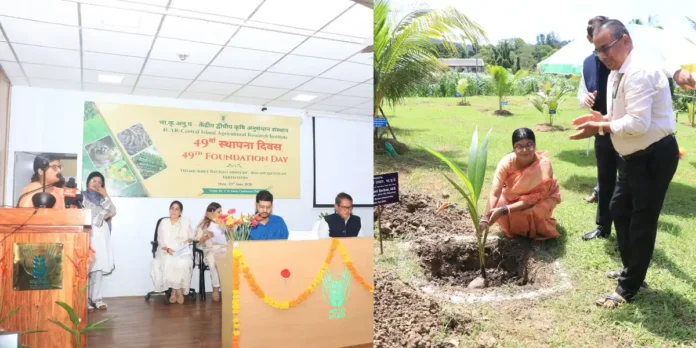
Sri Vijaya Puram, June 24: Expanding the reach of agricultural technologies to every farmer, promoting rural entrepreneurship and strengthening climate-resilient agriculture emerged as key priorities during the 49th Foundation Day celebrations of the ICAR-Central Island Agricultural Research Institute (ICAR-CIARI), as policymakers and agricultural experts outlined the challenges and opportunities facing island agriculture.
The event was held on June 23 at the Dr. T.R. Dutta Conference Hall of ICAR-CIARI’s Garacharma Research Complex in Sri Vijaya Puram. Pallavi Sarkar, IAS, Secretary (Agriculture, Animal Husbandry & Veterinary Services and Fisheries), Andaman and Nicobar Administration, attended as the chief guest, while K. Vijayapandian, General Manager, NABARD, was the guest of honour. The Foundation Day Lecture was delivered by Dr. A.K. Nayak, Deputy Director General (Natural Resource Management), ICAR, New Delhi. Dr. Jai Sunder, Director, ICAR-CIARI, presided over the programme.
Addressing the gathering, Pallavi Sarkar highlighted ICAR-CIARI’s role in supporting all aspects of island agriculture, including crop production, animal science, fisheries, natural resource management and rural development. As the institute approaches its Golden Jubilee year, she called for wider dissemination of technologies developed by the institute through its “One Technology a Day” initiative so that every farmer in the islands benefits from scientific advancements.

She also emphasized the need to address unemployment through skill development, entrepreneurship and startup promotion while urging greater integration of climate adaptation measures into agricultural research and development programmes.
Delivering the Foundation Day Lecture, Dr. A.K. Nayak praised ICAR-CIARI’s comprehensive approach to agricultural development and its contribution to improving the livelihoods of farmers in the Andaman and Nicobar Islands. He stressed the need for innovative and science-based solutions to address the growing impact of climate change on land, water and natural resources.
Dr. Nayak called for the development of a comprehensive contingency plan for the islands to address emerging challenges, including delayed monsoons linked to El Niño events. He also advocated location-specific livelihood models, improved food and nutritional self-sufficiency and the preparation of a State Action Plan–2047 that considers urbanisation, tourism expansion and resource pressures.

K. Vijayapandian emphasized that agricultural technologies must reach farmers at the grassroots level to generate meaningful socio-economic benefits. He also highlighted the importance of commercialising technologies and effectively utilizing the seven Geographical Indication (GI)-registered products from the Andaman and Nicobar Islands to create additional income opportunities for farmers.
Earlier, Dr. Jai Sunder presented the institute’s achievements and highlighted ongoing work in biodiversity conservation, integrated farming systems, natural resource management, organic and natural farming, post-harvest technology and entrepreneurship development. He informed that 18 crop varieties, including rice, green gram, black gram, brinjal, Malabar tamarind and bay leaf, have been recommended by the State Variety Release Committee for release.
The programme also featured exhibitions showcasing technologies, crop varieties and innovations developed by ICAR-CIARI and its Krishi Vigyan Kendras. A farmer-scientist interaction session enabled participants to discuss field-level challenges and receive scientific guidance. Six technical publications were released during the event, while progressive farmers, scientists and staff members were honoured for their contributions to agricultural development, technology dissemination and research excellence.