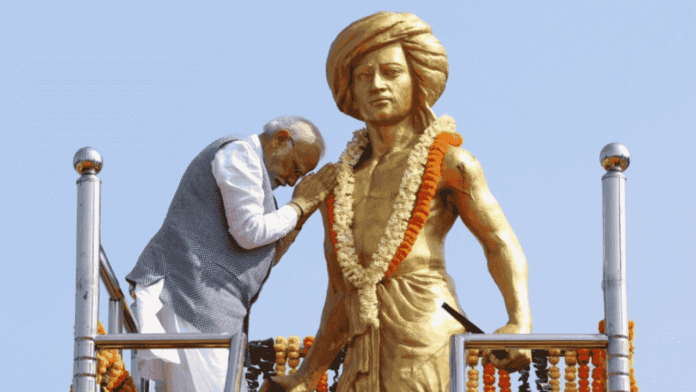
New Delhi, June 9: Prime Minister Narendra Modi on Tuesday paid tribute to tribal freedom fighter Birsa Munda on his martyrdom day, describing him as a symbol of courage, resistance and the struggle for the rights of India’s tribal communities.
In a message posted on social media, the Prime Minister remembered Birsa Munda’s contribution to the freedom movement and his efforts to protect the rights, culture and identity of indigenous communities during British colonial rule.
Offering homage to the revered tribal leader, Modi said Birsa Munda fought fearlessly against foreign rule to safeguard “jal, jungle aur zameen” (water, forests and land). He noted that the tribal icon dedicated his entire life to protecting the dignity, traditions and rights of tribal communities.
“The saga of his supreme sacrifice for the motherland will continue to inspire a spirit of patriotism in every generation of the country,” the Prime Minister said.
Birsa Munda is widely regarded as one of India’s most influential tribal leaders and freedom fighters. Born in 1875 in present-day Jharkhand, he emerged as a powerful voice against British colonial policies and the exploitation of tribal populations in the Chotanagpur region.
He led the historic Ulgulan, or “Great Tumult,” a mass movement that challenged colonial authority and opposed land policies that deprived tribal communities of their traditional rights over forests and agricultural land. The movement became a landmark chapter in India’s tribal resistance against British rule.
Through his leadership, thousands of tribal people were mobilised to demand recognition of their rights, identity and customary ownership of land. His campaign highlighted issues of economic exploitation, social injustice and cultural preservation at a time when tribal communities were facing increasing pressure from colonial policies and external influences.
Although his movement was concentrated in the Chotanagpur plateau, Birsa Munda’s legacy extends far beyond the region. His ideals continue to resonate among tribal communities across several states, including Assam, Odisha, Chhattisgarh and Jharkhand.
In Assam, particularly among tea garden communities whose ancestors migrated from the Chotanagpur region during the colonial era, Birsa Munda remains a revered figure. Many regard him as a symbol of resistance, self-respect and empowerment.
Recognition of Birsa Munda’s contributions has grown significantly in recent years. In 2021, the Government of India declared November 15, his birth anniversary, as Janjatiya Gaurav Divas to honour tribal freedom fighters and celebrate India’s rich tribal heritage.
The observance aims to highlight the role played by tribal leaders in India’s freedom struggle and promote awareness of their contributions to nation-building.
Birsa Munda’s life, however, was cut short at a young age. He died in British custody on June 9, 1900, at the age of just 25. Despite his brief life, his influence on tribal rights movements and India’s anti-colonial struggle remains profound.
More than a century after his death, Birsa Munda continues to be remembered as “Dharti Aaba” (Father of the Earth) by many tribal communities, symbolising the enduring fight for justice, dignity and the protection of indigenous rights.