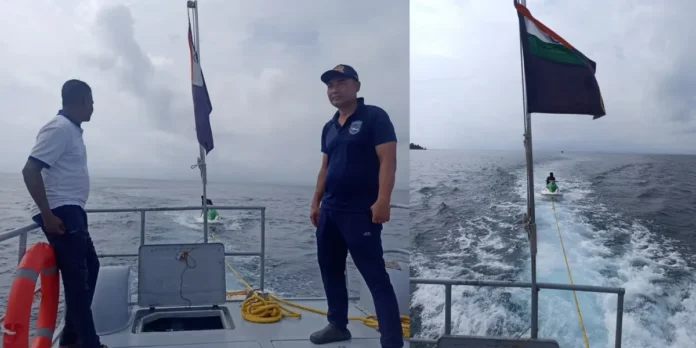
Sri Vijaya Puram, October 27: A jet ski capsized near the Lighthouse area off Swaraj Dweep on October 25 after an engine failure, prompting the Police Marine Force (PMF) to rescue the stranded rider and tow the watercraft to safety. The incident has raised questions over the risks of continuing water sports amid an official warning of rough to very rough sea conditions around the Andaman and Nicobar Islands.
The incident occurred during a routine maritime patrol when personnel aboard the marine patrol vessel MV Zulfiquar Ali spotted the capsized jet ski floating alongside its rider. The team responded by towing the stranded watercraft to the Floating Jetty at Swaraj Dweep, ensuring the rider’s safe return.
The patrol began at 9 am and concluded at 2.30 pm, covering the waters off Elephanta Beach and Swaraj Dweep. The team comprised Sub-Inspector (Marine) D. S. Dekate, Assistant Sub-Inspector (AED) Petrus Kujur, Police Constable 1883 Sagar Karketta and Head Constable 647 Saw Jackson.

The jet ski’s engine failure left the watercraft unable to operate, resulting in the incident near the Lighthouse area. The available details did not specify the cause of the mechanical failure or whether the rider sustained any injuries.
The incident comes as the Directorate of Disaster Management has issued an advisory warning of deteriorating sea conditions amid a developing weather system over the Bay of Bengal. According to the India Meteorological Department’s assessment cited in the October 25 advisory, the depression was expected to intensify over the following days, with rough to very rough seas forecast along and off the Andaman Islands.
The advisory urged the public to avoid tourism and recreational activities in accordance with official warnings and prevailing weather conditions. Fishermen were also advised not to venture into the east-central and adjoining southeast Bay of Bengal or waters along and off the Andaman Islands until October 26.
Against this backdrop, the jet ski incident underscores the potential consequences of undertaking marine activities without adequate precautions when weather warnings are in place. While there is no information establishing a direct link between the developing depression and the capsizing, the episode illustrates how a mechanical failure can become more dangerous when a watercraft is stranded at sea.
In coastal destinations such as Swaraj Dweep, where water sports are a major tourist attraction, safety depends on more than the availability of rescue services. Operators and participants need to assess prevailing sea conditions, follow official advisories and comply with any restrictions imposed by authorities. Mechanical checks, appropriate safety equipment and access to emergency assistance are also essential to reducing risks.
A disabled watercraft can leave a rider vulnerable to changing sea conditions, currents and waves. Without timely assistance, a situation involving engine failure could escalate into a serious emergency, potentially placing rescuers at risk as well. The successful intervention by the PMF prevented the incident from developing further, although details about the rider’s condition and the circumstances leading to the capsizing remain unavailable.

The incident also highlights the importance of ensuring that water sports operations respond promptly to weather alerts. When authorities warn of rough seas, operators must prioritise safety over routine activities and ensure that decisions to proceed are consistent with official directions and actual sea conditions.
The PMF conducts maritime patrols and responds to emergencies at sea as part of its coastal safety and security responsibilities across the islands. Its intervention on October 25 ensured that both the rider and the jet ski were brought safely to the Floating Jetty at Swaraj Dweep.
As the weather system develops, residents, tourists and water sports operators have been urged to follow updates from the India Meteorological Department and the Andaman and Nicobar Administration. The incident serves as a reminder that ignoring warnings or overlooking safety precautions can turn a routine recreational activity into a potentially life-threatening emergency.