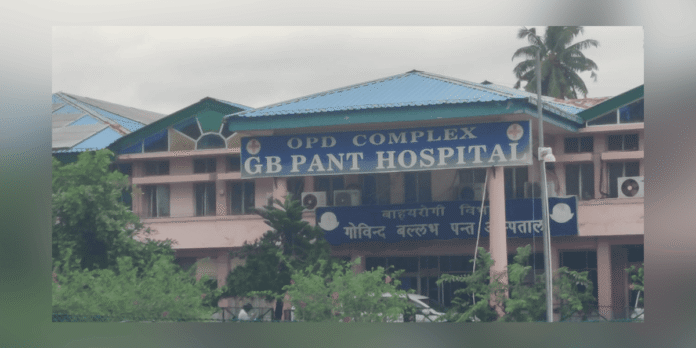
Sri Vijaya Puram, October 17: Repeated complaints over shortages of diagnostic facilities, surgical supplies and critical equipment at G.B. Pant Hospital have raised questions about procurement, maintenance and administrative oversight at the Andaman and Nicobar Islands’ principal government referral hospital, even as the Administration has issued directions to address deficiencies in patient care.
A September 3 representation to the Lieutenant Governor and Chief Secretary has sought an immediate inspection, uninterrupted diagnostic services and a time-bound report identifying deficiencies, the officials responsible for addressing them and the corrective measures taken.
The representation was submitted by Ealiyamma John, Managing Trustee of Salvation Fellowship Trust, an Andaman-based voluntary organisation that has worked with children with visual, hearing and intellectual disabilities. The organisation has previously been listed in a Government of India document as a state nodal agency centre under the National Trust, a statutory body supporting persons with disabilities.
The appeal comes amid a series of complaints involving unavailable laboratory tests, patients allegedly being asked to purchase surgical supplies from private pharmacies and non-functional medical equipment. While the Health Department and Lieutenant Governor have announced corrective measures, the recurring nature of these concerns has brought the hospital’s systems for monitoring supplies and maintaining equipment under scrutiny.
The central question is whether shortages are being identified and addressed before they disrupt treatment, rather than after complaints reach senior officials.

Who is accountable for shortages?
The representation has sought uninterrupted availability of basic investigations, including haemoglobin tests, complete blood counts, serum creatinine and other renal-function tests. These are routinely required for surgical assessments, emergency treatment and monitoring patients undergoing dialysis.
It has also called for adequate stocks of reagents, test kits and consumables, round-the-clock laboratory services and sufficient equipment for urological procedures, including prostate-related surgeries.
On September 8, The Wave Andaman reported that a temporary shortage of laboratory reagents had disrupted certain diagnostic tests at G.B. Pant Hospital.
The Health Department subsequently sanctioned Rs 9 crore for laboratory consumables and issued supply orders for the required reagents, with the affected tests expected to resume following their arrival.
The episode raises questions about why essential reagents were allowed to run short, whether adequate buffer stocks were maintained and whether procurement requirements were identified sufficiently in advance.
The sanctioning of additional funds addresses the immediate supply requirement, but does not by itself establish what caused the disruption or whether safeguards have been introduced to prevent its recurrence.
Separately, TSG Bhasker, Chairman of the Campaign Committee of the Andaman and Nicobar Territorial Congress Committee, alleged that some patients were being asked to purchase surgical consumables, gloves, injections, orthopaedic implants and other medical supplies from private pharmacies before undergoing procedures.
He sought an enquiry into procurement, storage and distribution practices, including supplies purchased through the Government e-Marketplace.
The allegations have not been independently established and require examination by the competent authorities.
The Directorate of Health Services subsequently directed government hospitals not to ask patients or their attendants to purchase surgical consumables and other essential treatment-related items from private pharmacies.
Patients facing such demands were advised to report them to the Director of Health Services for examination and appropriate action.
However, the directive leaves an important accountability question: whether the Administration has examined how such alleged practices arose, whether essential supplies were unavailable despite procurement arrangements and what action, if any, has followed the complaints.
LG orders corrective measures
During his September 27 inspection of G.B. Pant Hospital, Lieutenant Governor Dr. Dinesh Sharma reviewed the pharmacy, pathology laboratory and clinical departments and interacted with patients and attendants.
He directed officials to maintain adequate stocks of essential medicines, reactivate the Public Medicine Center and expedite proposals for laboratory machines that were unavailable.
He also called for repairs to the non-functional MRI facility and defective ventilators, alongside measures to strengthen cancer and cardiology services.
The inspection also covered the availability of junior doctors and the need for greater stability in doctors’ tenure.
Other steps included tighter sanitation monitoring, reorganisation of patient registration through six counters and additional seating near the ICU and Surgical Ward.
Air coolers were subsequently installed in the waiting area used by relatives and attendants of Nicobari patients, while a proposal for a patient-attendant residence within the hospital premises was also sought.
These interventions have brought attention to immediate deficiencies, but the larger test will be whether the directions result in sustained improvements.
In particular, the Administration needs to establish whether repairs to critical equipment have been completed, whether laboratory services have resumed without interruption and whether procurement and inventory systems are capable of anticipating shortages.
Patients bear the cost
The representation has highlighted the financial and logistical burden on patients who are directed to private diagnostic centres when investigations cannot be conducted at G.B. Pant Hospital.
For residents travelling from remote islands, particularly the Nicobar group, reaching Sri Vijaya Puram can already involve substantial transportation and accommodation expenses.
Being asked to independently arrange essential tests can add to these costs and delay treatment, particularly for elderly, critically ill and economically vulnerable patients.
The trust has therefore sought restoration or formalisation of an earlier arrangement under which the hospital collected samples and sent them to local laboratories whenever investigations were unavailable in-house.
Under the proposed system, diagnostic centres would be empanelled transparently, rates would be approved by the government and a monitoring mechanism would guard against excessive charges.
Where permissible, payments could be handled through an appropriate government or hospital mechanism rather than requiring patients to bear the entire cost upfront.
In emergencies, the Medical Superintendent or an authorised medical officer could be empowered to arrange immediate testing, subject to documentation and audit.
Such an arrangement would also make it possible to track how frequently hospital tests are unavailable, the reasons for outsourcing and the costs incurred as a result.

Wider infrastructure gaps
Concerns about G.B. Pant Hospital extend beyond laboratory services and surgical supplies.
Earlier reporting by The Wave Andaman highlighted patients being accommodated on mattresses on the floor amid a shortage of beds, prompting demands for an additional 100-bed ward, a dedicated trauma centre, more operating theatres and separate post-operative wards.
Shortages of specialists in cardiology, neurology and nephrology have also been raised, alongside demands for stronger gynaecology services in North and Middle Andaman and Nicobar.
More recently, Member of Parliament Bishnu Pada Ray flagged deficiencies in the hospital’s mortuary and post-mortem facilities.
In an October 10 letter, Ray reported that four of the hospital’s eight dead-body freezer boxes were non-functional. He also raised concerns over a generator failure and malfunctioning post-mortem equipment.
The complaints point to the need for a systematic review of equipment maintenance, repair timelines and responsibility for ensuring that essential facilities remain operational.
The September 3 representation has sought a comprehensive inventory and monitoring mechanism covering medicines, laboratory reagents, surgical consumables and medical equipment.
It has also called for a time-bound action-taken report from the Directorate of Health Services and the Medical Superintendent, identifying deficiencies and the measures implemented to address them.
The recurring complaints raise a larger issue of public accountability. The Administration has announced interventions and issued instructions, but the effectiveness of those measures will depend on whether shortages are prevented, equipment is restored to service and patients receive treatment without avoidable delays or additional expenses.
For the Islands’ principal referral hospital, accountability cannot end with the sanctioning of funds or the issuance of directions. It must extend to verifying that essential services are available when patients need them and establishing responsibility when they are not.