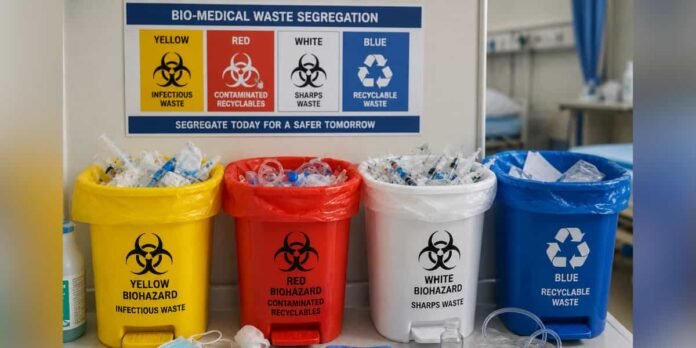
Sri Vijaya Puram, May 11: The Andaman and Nicobar Pollution Control Committee (ANPCC) has directed all healthcare facilities operating in the Andaman and Nicobar Islands to strengthen compliance with statutory provisions related to biomedical waste management and pollution control.
Officials stated that under the provisions of the Bio-Medical Waste Management Rules, 2016, every biomedical waste generator is required to obtain mandatory authorisation for the generation, handling, treatment, processing and disposal of biomedical waste.
In addition, healthcare facilities are also required to obtain Consent to Establish (CTE), Consent to Operate (CTO) and renewals under the Water (Prevention and Control of Pollution) Act, 1974 and the Air (Prevention and Control of Pollution) Act, 1981.

According to ANPCC, these permissions and authorisations must be obtained through the Online Consent Management and Monitoring System (OCMMS) portal.
The Pollution Control Committee observed that several healthcare facilities functioning in the Islands are required to improve compliance with the existing environmental and waste management regulations.
Authorities have therefore urged all government and private healthcare facilities to ensure strict adherence to the Bio-Medical Waste Management Rules, 2016 and subsequent amendments.
ANPCC stated that all healthcare facilities must obtain valid CTE and CTO clearances along with biomedical waste authorisation from the Committee through the official portal: ANPCC OCMMS Portal.

Officials further explained that healthcare facilities are categorised based on their pollution potential under the revised classification system issued by the Central Pollution Control Board (CPCB).
Under the classification, healthcare facilities with 501 to more than 1000 beds fall under the Red category, facilities with 201 to 500 beds are categorised under Orange category, while facilities with up to 200 beds fall under the Green category.
The Committee stated that all healthcare facilities with more than 10 beds are required to install appropriate Effluent Treatment Plants (ETPs) for scientific treatment of wastewater before discharge.
Healthcare facilities operating captive incineration systems have also been instructed to install Online Continuous Emission Monitoring Systems (OCEMS) with real-time transmission of emission data to CPCB servers.
For healthcare facilities located in isolated and remote areas, ANPCC stated that the deep burial method may be adopted for disposal of yellow category biomedical waste, subject to authorisation and compliance with standards prescribed under Schedule II of the BMWM Rules, 2016.
The Committee further clarified that bedded healthcare facilities not connected to sewerage systems or lacking terminal treatment facilities must comply with discharge standards specified under Schedule II of the Bio-Medical Waste Management Rules.
Facilities connected to public sewerage systems with terminal treatment infrastructure are required to comply with general discharge standards notified under the Environment (Protection) Act, 1986.
Healthcare facilities having less than 10 beds must also follow discharge standards prescribed under Schedule II, while non-bedded occupiers are required to disinfect infectious liquid waste before disposal as per prescribed guidelines.
Officials stated that proper biomedical waste management is essential to prevent environmental pollution, protect public health and ensure safe disposal of infectious and hazardous medical waste.
ANPCC has advised all healthcare institutions in the Islands to immediately review their waste management systems and ensure full compliance with the applicable environmental regulations and statutory requirements.
The Committee warned that failure to comply with the prescribed rules and pollution control norms may attract action under the relevant environmental laws.