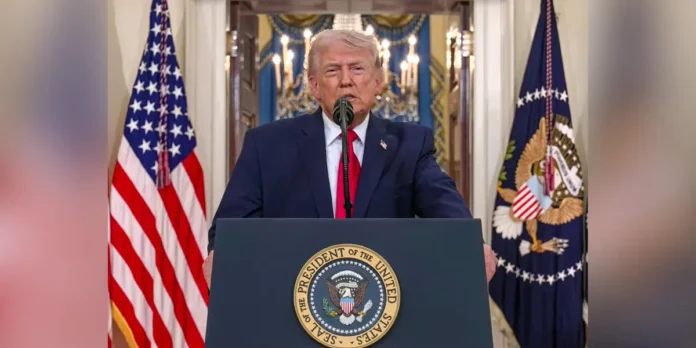
Washington, June 24: US President Donald Trump has defended his administration’s tariff-driven trade policy, arguing that import duties on foreign goods are helping revive domestic manufacturing, attract investment and strengthen America’s industrial base.
Addressing workers at a Mack Trucks manufacturing facility in Macungie, Pennsylvania, Trump presented tariffs as a central pillar of his economic strategy and credited the measures with encouraging companies to establish production facilities within the United States rather than overseas.
The President said the policy was designed to reverse decades of manufacturing decline that, according to him, had resulted in factory closures and job losses across industrial regions. He told workers that his administration had prioritised domestic industry and employment through trade measures aimed at protecting American manufacturers from foreign competition.

Trump highlighted tariffs imposed on imported steel, aluminium, copper, automobiles and heavy-duty trucks, stating that the duties were intended to safeguard domestic jobs and support US-based production. He noted that a 25 per cent tariff had been placed on imported automobiles and medium- and heavy-duty trucks, while tariffs on certain metal imports had been increased to 50 per cent.
According to Trump, manufacturers seeking to avoid tariff costs are increasingly shifting production to the United States. He claimed that the country is witnessing an unprecedented wave of industrial investment, including new automobile manufacturing plants, artificial intelligence facilities and other large-scale industrial projects.
The President argued that companies can avoid tariffs by manufacturing products domestically and employing American workers. He maintained that the strategy is contributing to greater industrial activity and expanding the country’s manufacturing footprint.
Trump also linked the tariff policy to improvements in the nation’s trade position. He claimed that the United States had achieved a substantial reduction in its trade deficit with China and reported growth in American exports to international markets. According to the President, these developments demonstrate the effectiveness of tariff-based trade measures in strengthening the domestic economy.
The speech was delivered at the Mack Trucks facility, one of the country’s leading heavy-duty truck manufacturing plants. Trump described the company and its workforce as examples of American industrial strength and manufacturing capability.

During the event, Patrick McHugh, a Marine Corps veteran and third-generation employee of Mack Trucks, said the company remains committed to producing vehicles in the United States and contributing to domestic industry.
Trump also cited investment announcements in Pennsylvania involving pharmaceutical manufacturer Eli Lilly, telecommunications company Nokia and medical technology firm B. Braun. He said these projects reflected growing confidence in the American economy and manufacturing sector.
The President’s remarks come as tariffs continue to occupy a central place in US economic policy discussions. Supporters argue that such measures strengthen domestic production and industrial capacity, while critics contend that tariffs can increase costs for businesses and consumers. The debate remains a key issue in discussions surrounding trade, manufacturing and economic competitiveness in the United States.