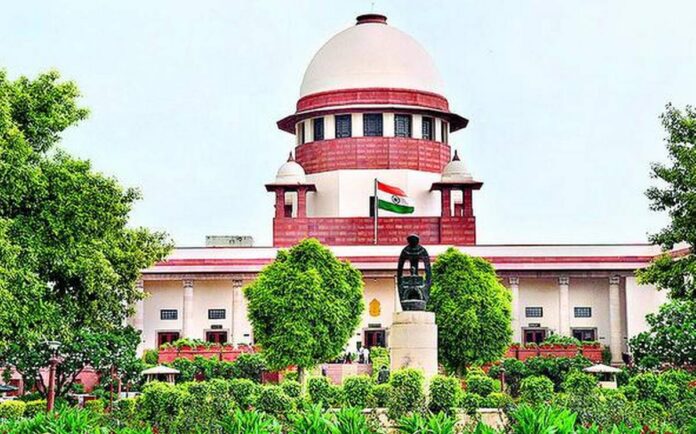
New Delhi, May 11: The Supreme Court has sought compliance reports from multiple states and Union Territories, including the Andaman and Nicobar Islands, over the implementation of the 25 per cent reservation mandate for economically weaker and disadvantaged children under the Right to Education Act, warning that failure to respond could lead to senior education officials being summoned before the court.
A Bench comprising Justices Vikram Nath, Sandeep Mehta and Vijay Bishnoi issued the direction while hearing a writ petition filed by Md Imran Ahmad regarding the implementation of Section 12(1)(c) of the Right of Children to Free and Compulsory Education Act, 2009.
The provision mandates private unaided schools to reserve 25 per cent seats for children belonging to weaker and disadvantaged sections of society.

During the proceedings, senior advocate Salman Khurshid, appearing for the petitioner, submitted a detailed chart categorising states and Union Territories into five categories based on the status of implementation of the provision.
According to the submissions, some states and Union Territories had allegedly refused to implement the provision altogether, while others were accused of framing rules aimed at bypassing or weakening the mandate under the RTE Act.
Another category included states and UTs that had either remained silent on the issue or failed to frame rules for implementation. Some states were listed as having partially implemented the provision, while others claimed compliance but had not submitted documentary proof before the Supreme Court.
Taking note of the concerns, the apex court granted four weeks to Punjab, West Bengal, Kerala, Goa, Arunachal Pradesh, Meghalaya, Nagaland and the Union Territory of Puducherry to file affidavits regarding the “true and faithful implementation” of Section 12(1)(c).
The court warned that if affidavits were not filed within the stipulated period, it could summon the Principal Secretaries of the respective Education Departments.
The Bench further recorded that the Union Territories of Ladakh, Jammu and Kashmir, and the Andaman and Nicobar Islands, along with the states of Mizoram and Sikkim, were not represented during the hearing.
The Supreme Court directed its registry to send copies of the order to the Chief Secretaries and standing counsel of the concerned states and Union Territories within one week and instructed authorities to ensure compliance within the prescribed timeline.
The matter has been scheduled for further hearing on July 22.

The case has remained under active consideration before the apex court for several months. Earlier in February, the court had expressed dissatisfaction over delays in filing responses and warned that Chief Secretaries of Telangana, Punjab and Jammu and Kashmir could be directed to appear personally if affidavits were not submitted.
Subsequently, during a hearing in March, counsel for the petitioner informed the court that all states had filed their responses. However, concerns regarding actual implementation and verification of compliance continued to persist.
In a separate recent ruling linked to denial of admission under the RTE quota in Uttar Pradesh, the Supreme Court reiterated that schools allotted students under the 25 per cent reservation framework carry a binding constitutional and statutory obligation to grant admission.
The apex court had observed that the right to education guaranteed under Article 21A of the Constitution would remain ineffective if the provisions of the RTE Act were not implemented “in letter and spirit.