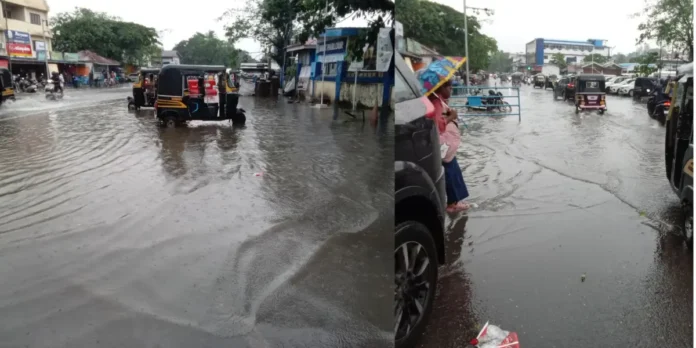
Sri Vijaya Puram, June 2: Persistent waterlogging in the city’s main market area continues to disrupt daily life whenever moderate rainfall occurs, with residents and business owners once again raising concerns over what they describe as a long-standing civic problem that remains unresolved despite repeated complaints.
Even two to three hours of rain is enough to leave several stretches of the market submerged, affecting not only commercial establishments but also key public spaces and transport hubs. Local residents say the problem extends beyond the main market area, impacting roadside eateries, small shops, restaurants, auto-rickshaw stands and even the Municipal parking area during periods of rainfall.
The recurring flooding has become a familiar sight during the monsoon season, with water accumulating on roads and surrounding premises as drainage channels struggle to cope with the volume of rainwater. As a result, pedestrians, motorists and public transport operators often face significant inconvenience while navigating waterlogged streets.

Shopkeepers and local vendors are among the worst affected. Many small businesses report that rainwater frequently enters their premises, damaging goods and disrupting normal operations. For vendors operating in low-lying areas, even a few hours of rainfall can result in financial losses and reduced customer footfall.
Residents and traders maintain that the issue is not a recent development but a chronic problem that has persisted for years without a permanent solution. According to local observations, drainage infrastructure in several parts of the market area appears inadequate to handle rainfall efficiently, resulting in overflowing drains and water spilling onto roads and adjoining properties.
Auto-rickshaw drivers operating in the area also face challenges during waterlogging incidents, as flooded roads slow traffic movement and make passenger pick-up and drop-off difficult. Commuters, particularly those travelling on foot, are often forced to wade through stagnant water to access shops, transport services and other facilities.
While many affected traders privately acknowledge the difficulties they face, several remain reluctant to speak publicly or on camera about the issue. Despite this hesitation, the impact of recurring flooding is visible across the market whenever heavy rain occurs.
The situation has renewed questions about urban infrastructure and drainage management in the city. Residents point out that while discussions surrounding urban modernization and Smart City initiatives continue, basic civic issues such as effective stormwater drainage and flood mitigation remain unresolved.
Many believe that recurring waterlogging not only affects business activity and public convenience but also poses potential health concerns due to stagnant water accumulation. During prolonged flooding, residents often express fears about sanitation issues and mosquito breeding in waterlogged areas.

Local stakeholders have called upon the authorities to undertake a comprehensive assessment of the drainage network in and around the market area. They argue that temporary measures have failed to provide lasting relief and that long-term interventions are necessary to address the root causes of the problem.
Among the suggestions raised by residents are the desilting and widening of drains, regular maintenance of stormwater channels, removal of blockages and improvements to water discharge systems in low-lying areas prone to flooding.
With the monsoon season gathering pace, affected residents and business owners say the need for a permanent solution has become increasingly urgent. They have urged the administration and civic authorities to prioritize drainage improvements to ensure that routine rainfall does not continue to disrupt commerce, transportation and daily life in one of the city’s busiest commercial areas.