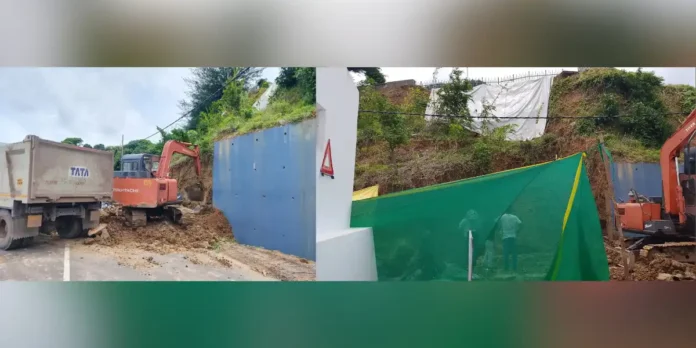
Sri Vijaya Puram, August 11: The collapse of a newly constructed retaining wall near the Japanese bunker along Seashore Road has raised fresh questions over the durability of public infrastructure and the accountability of agencies executing works under the Smart City programme.
The retaining wall reportedly gave way following recent rainfall and gusty weather in the area. While the exact cause of the collapse is yet to be established, the incident has drawn attention to whether infrastructure designed for the island’s terrain and climatic conditions is adequately engineered to withstand the pressures routinely associated with the monsoon.
The concern assumes significance because retaining walls are critical structures in areas with slopes and vulnerable terrain. Their design and construction typically have to account for factors including soil characteristics, drainage, slope stability, rainfall intensity and water accumulation behind the structure.
In the Andaman and Nicobar Islands, where rainfall is an inherent part of the local climate, these considerations are particularly important. The question, therefore, is not merely why a wall collapsed after rain, but whether the infrastructure was designed and executed with the region’s predictable weather and terrain conditions adequately factored into the planning.
The latest incident has also brought back memories of another retaining wall collapse reported a few months ago near the Science Centre, opposite the High Court Judge’s residential complex. The recurrence of such incidents has inevitably prompted questions about the quality, supervision and durability of civil works being undertaken across Sri Vijaya Puram.

What makes the latest collapse particularly significant is that the wall was understood to be a relatively recent construction under the Smart City programme. Public infrastructure created through such programmes is funded ultimately through public money, making its durability and quality a matter of public interest.
The Smart City initiative was intended to improve urban infrastructure and resilience, among other objectives. Consequently, residents are justified in asking whether newly constructed structures are capable of performing for the period for which they were designed.
It would, however, be premature to conclude that poor construction or substandard material was responsible for the collapse without a technical assessment. A proper engineering investigation would need to establish whether the failure resulted from excessive soil pressure, inadequate drainage, slope movement, foundation issues, construction deficiencies, unusually high water saturation or another factor.
That investigation is precisely what makes the incident important.
If rainfall was the primary trigger, authorities would need to explain whether the structure was designed to withstand foreseeable monsoon conditions. If drainage or water accumulation contributed to the failure, questions would arise over whether adequate provisions were incorporated into the design. And if construction or material quality played a role, responsibility would have to be fixed on the agencies or contractors concerned.
The broader issue is one of accountability.
Residents and taxpayers cannot reasonably be expected to repeatedly bear the cost of repairing infrastructure that has failed soon after construction. Every reconstruction or remedial exercise potentially means additional expenditure, while the original public investment remains at stake.
The collapse also raises a more fundamental question about how urban infrastructure is planned for an island environment. Rainfall, steep slopes, soil conditions and coastal exposure are not unexpected occurrences in Sri Vijaya Puram. They are permanent characteristics of the region.
Therefore, climate and terrain resilience cannot be treated as exceptional considerations in the design of retaining walls and other civil structures.
The administration and agencies responsible for the project now face a series of questions: Who designed the retaining wall? Which agency executed the work? Who supervised and certified its construction? What were the technical specifications? Was a soil and slope stability assessment undertaken? Were adequate drainage arrangements provided? What was the estimated lifespan of the structure? And was the work inspected before being opened for public use?

Most importantly, who will be held accountable if an independent technical assessment establishes that the failure was preventable?
The collapse near the Japanese bunker should not merely become another repair-and-rebuild exercise. It presents an opportunity for the authorities to establish what went wrong, make the findings public and ensure that similar failures are not repeated.
For residents, the issue goes beyond a damaged wall. It concerns the quality of public infrastructure, the use of taxpayers’ money and whether accountability accompanies the spending of that money.
The question now remains: who is answerable when infrastructure built to strengthen the city itself fails under conditions that the city has long been expected to withstand?