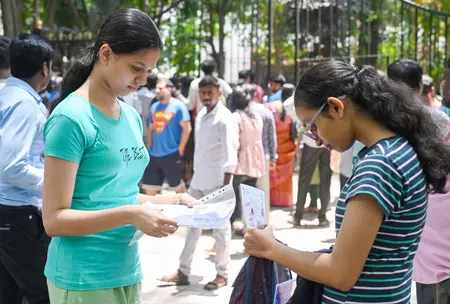
New Delhi, Aug 29: More than 2.73 lakh medical graduates will appear for NEET-PG 2026 on Sunday, August 30, with the examination scheduled across 1,300 centres in 340 cities and authorities putting in place a multi-layered security framework to protect the integrity of the high-stakes medical entrance test.
The National Board of Examinations in Medical Sciences (NBEMS) has registered 2,73,183 candidates for this year’s examination, marking an increase of more than 12.5 per cent over the previous year. The test will be conducted in a single shift.
The examination will determine eligibility for admission to advanced medical courses, including MD (Doctor of Medicine) and MS (Master of Surgery), offered by government and private medical colleges. NBEMS released the admit cards for the examination on August 26.

Union Health and Family Welfare Minister J.P. Nadda recently reviewed preparations for the examination and directed the agencies involved to ensure a secure, transparent, technology-enabled and candidate-friendly process.
The security arrangements include CCTV surveillance, biometric authentication, frisking, signal jammers, dynamic computer allocation and live monitoring through central and regional command centres. More than 60,000 examination personnel have been deployed as part of the arrangements.
During the review, Nadda assessed preparations by NBEMS, technology partners and other agencies involved in conducting the examination. Officials briefed him on logistics, candidate facilitation, security measures and technology-based interventions introduced for this year’s test.
Authorities have also warned candidates against rumours and fraudulent claims concerning the examination. Nadda said the final question paper is selected through a secure, encrypted and time-bound process shortly before the examination begins, with technological and operational safeguards intended to protect its confidentiality until the scheduled start. He said claims of prior access to the paper are false and intended to mislead candidates.

Candidates have been advised to rely only on official communications from NBEMS and the Ministry of Health and Family Welfare and report suspicious activity or attempts at unfair practices.
Several changes have also been introduced to facilitate candidates. Aspirants were allowed to indicate three preferred states for test centres, with their correspondence state required as the first preference. Officials said test-city information was communicated nearly three weeks before the examination, allowing candidates time to plan travel and accommodation.
The examination pattern has been revised to 180 questions to be answered in 210 minutes, giving candidates more time per question. Aadhaar-based authentication has been incorporated at both registration and examination stages, while iris-based biometric verification will provide a backup where fingerprint authentication fails.