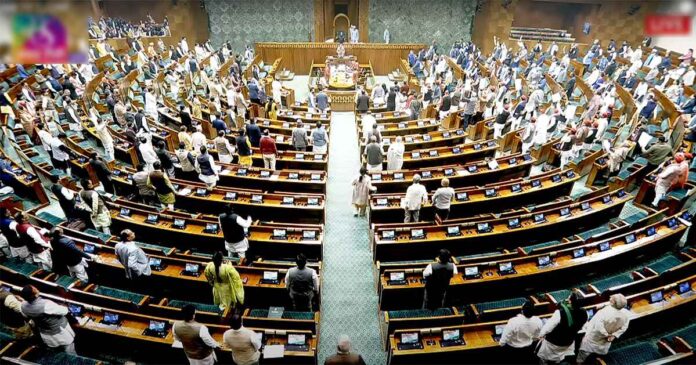
New Delhi, April 18: In a dramatic setback for the Union government, the Lok Sabha on Friday rejected the Constitution (131st Amendment) Bill, derailing a key proposal to expand Parliament and operationalise one-third reservation for women in legislatures from 2029.
After two days of intense and often polarised debate, the Bill secured 298 votes in favour and 230 against. However, it fell short of the two-thirds majority required for Constitutional amendments, leading to its defeat. The outcome has stalled not only the proposed expansion of the Lok Sabha but also the long-awaited implementation timeline for women’s reservation, leaving a major reform effort in uncertainty.
The proposed legislation sought to increase the strength of the Lok Sabha from 543 to 850 seats, linking this expansion to a nationwide delimitation exercise based on updated population data. The Bill also aimed to implement 33 per cent reservation for women in the Lok Sabha and state Assemblies, a promise that had been legislated in principle but deferred pending delimitation.
Delimitation fault lines stall reform
The government maintained that the move was necessary to address the growing imbalance between voters and elected representatives, a disparity that has widened since constituency boundaries were frozen based on the 1971 Census. It argued that expanding seats alongside delimitation would ensure fairer and more proportional representation across states.
Prime Minister Narendra Modi and Union Home Minister Amit Shah strongly advocated for the Bill, framing it as a historic step toward women’s empowerment. They warned that the electorate, particularly women, would closely watch the stance taken by political parties. The government also sought to counter concerns from southern states, asserting that fears of losing representation were unfounded and that the exercise would ensure equitable distribution.
However, the Opposition remained firmly opposed, arguing that linking women’s reservation to delimitation masked a deeper political agenda. Several parties contended that the proposed redistribution of seats would disproportionately benefit northern states with higher population growth, while penalising southern states that have achieved demographic stabilisation.
Leader of Opposition Rahul Gandhi made it clear during the debate that his bloc would not support the Bill under any circumstances, reinforcing a united stand against the government’s approach. Opposition leaders also criticised the sequencing of reforms, insisting that women’s reservation should not be contingent upon delimitation.
The sharp divide over federal balance and representation ultimately proved decisive, preventing the government from building the consensus required for a Constitutional amendment.

Political messaging dominates outcome
The Bill’s defeat also led to the shelving of two related proposals, the Delimitation Bill and amendments to extend similar provisions to Union Territories, including Delhi, Puducherry, and Jammu & Kashmir. Parliamentary Affairs Minister Kiren Rijiju confirmed that these would not be taken up following the setback, citing their interlinked nature.
Despite the legislative loss, the political battle extended beyond the vote itself. The government moved swiftly to frame the Opposition as obstructing women’s empowerment and equitable representation. Ministers argued that rejecting the Bill amounted to denying women a long-promised share in political power.
During the debate, Amit Shah accused the Congress of historically opposing delimitation and reservation measures, presenting the current resistance as a continuation of that stance. He also rejected claims that southern states would be disadvantaged, stating that data did not support such fears.
On the other hand, Opposition parties projected the outcome as a victory against what they described as a politically loaded exercise. They argued that the government was attempting to push through structural changes to representation under the cover of gender justice, without adequately addressing regional concerns.
The competing narratives underscored the broader political stakes, particularly with key state elections approaching in regions such as Tamil Nadu and West Bengal. While the Opposition celebrated blocking the Bills, analysts note that it may face challenges in countering the perception that it opposed a measure framed around women’s empowerment.
The episode highlights the complexity of reforms that intersect constitutional design, federal balance, and social justice. While the framework for women’s reservation was laid down in 2023, its implementation remains tied to delimitation, which now stands delayed once again.
For the government, the defeat marks a rare legislative reversal, exposing the limits of its parliamentary strength in pushing through Constitutional changes. For the Opposition, it represents both a tactical success and a potential messaging challenge.
For women seeking greater representation in legislatures, however, the immediate outcome is one of continued uncertainty. The promise of guaranteed political participation remains in limbo, contingent on future consensus over how India redraws its electoral map while balancing competing regional and demographic realities.