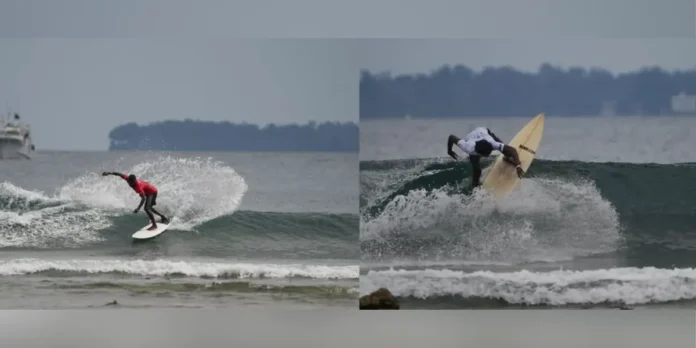
Sri Vijaya Puram (Port Blair), April 15: Little Andaman has moved decisively onto India’s surf travel map after the successful hosting of the Little Andaman Pro 2026 at Butler Bay, a national championship that has helped push the island from relative obscurity into the country’s growing adventure-tourism conversation.
The event brought competitive intensity as well as visibility. In a thrilling Surfing Men’s Open final that kept spectators on edge, Sivaraj Babu emerged national champion with a score of 13.63, edging past Srikanth D by just 0.30 points after the latter finished at 13.33. Kishore Kumar followed closely with 12.87, while Sanjay Selvamani scored 9.30 in a fiercely contested heat. In the Surfing Women’s Open final, Kamali Moorthy delivered a commanding performance to retain her title, posting 15.83 and winning by 4.19 points over Sugar Shanti Banarse, who finished at 11.64. Devi Ramanathan scored 7.84, while Riva Aurora ended at 5.23.
But the real story lies beyond the scoreboard. The championship has drawn fresh attention to Butler Bay’s geography and to the natural conditions that have made it one of the most promising surf locations in India. Little Andaman sits south of the main Andaman chain, separated by the Duncan Passage and positioned in a more open maritime setting than the islands more familiar to tourists. That relative isolation is part of its appeal. Butler Bay, on the island’s western edge, faces a wider sweep of ocean and receives the southern swells that give the break its energy and shape.

Where waves build
For surfers, that geography matters. Butler Bay is known for long, clean rides, with a mix of beach and reef breaks that produce both left and right waves. The surf here is usually driven by southern groundswells, while west winds help groom the wave face and keep conditions cleaner. That combination gives the bay a consistency and technical quality unusual by Indian standards. It also means the break can reward both flowing rides and sharper, more competitive manoeuvres, which is one reason it has become suitable for national-level events.
Seen from the shore, Butler Bay still feels far removed from the crowded image of mainstream beach tourism. The water is clear and warm, the beach remains open and relatively uncrowded, and the surrounding landscape retains the sense of a place that has not yet been overbuilt. That is central to its growing reputation. In many global surf destinations, wave quality now competes with crowd pressure. At Butler Bay, the attraction lies as much in space and setting as in the surf itself.
That is what makes Little Andaman distinct. It is not simply another tropical beach location being packaged as an adventure stop. It has the raw ingredients of a genuine surf destination: wave quality, warm water, low crowd density, and a landscape that gives the experience a feeling of discovery. The Little Andaman Pro 2026 has effectively taken those qualities and put them before a wider audience.

The event also marks a wider shift in how tourism in the islands is being imagined. Surfing is beginning to offer Little Andaman a sharper identity, one rooted not just in scenic beauty, but in experience. Instead of being seen only as a remote extension of the Andamans, the island is starting to emerge as a destination in its own right, with Butler Bay at the centre of that change.
That has implications beyond sport. Surf tourism tends to generate a different kind of travel economy, one built around repeat visitors, surf schools, guiding, homestays, transport, cafés and local services rather than high-volume package tourism. For a place like Little Andaman, that creates the possibility of growth without immediately sacrificing character.
For now, Butler Bay remains in that rare stage where recognition is rising, but the place still feels open, raw and lightly touched. The Little Andaman Pro did not invent its appeal. It simply revealed what geography, swell and time had already shaped, a stretch of coast that may well become the defining centre of India’s surfing story.