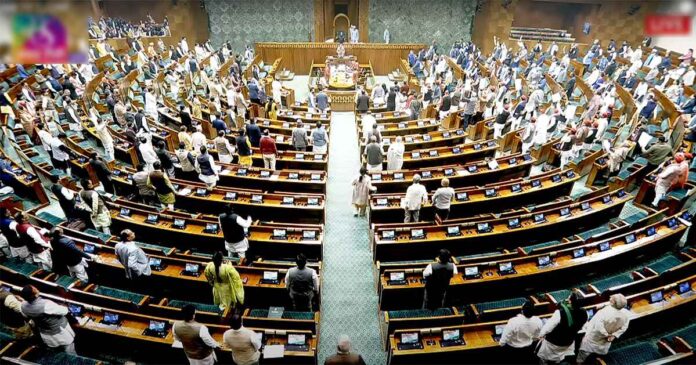
New Delhi, April 15: The Union government on April 14 placed before Members of Parliament the draft of the Constitution (131st Amendment) Bill, 2026, proposing a major expansion of the Lok Sabha to 850 seats and paving the way for the early implementation of women’s reservation in Parliament and state Assemblies.
The proposed legislation caps the number of directly elected representatives from States at 815, while providing for a maximum of 35 members to represent Union Territories, to be chosen in a manner determined by Parliament. At present, the Lok Sabha comprises 530 members from States and 20 from Union Territories, with the total strength fixed at 543 following earlier delimitation.
A key provision in the Bill redefines the term “population” under Article 81 of the Constitution. It empowers Parliament to determine which census data will be used as the basis for seat allocation. The amendment specifies that population figures will be drawn from a census notified by law, with officially published data forming the basis for recalibration.

The Cabinet has cleared the Bill as part of efforts to operationalise the 33 per cent reservation for women in the Lok Sabha and state legislatures. The proposed amendment seeks to delink the implementation of the quota from the 2027 Census and instead base it on the 2011 Census, enabling its rollout ahead of the 2029 general elections.
Further changes have been proposed to Article 82, which governs the allocation of seats following a census. The Bill replaces the phrase “upon the completion of each census” with “the allocation of seats,” signalling a shift in how and when seat distribution may be undertaken.
The amendment also assigns a clearer role to the Delimitation Commission. It proposes that seat allocation be carried out “in such manner and on the basis of such census, by the Delimitation Commission,” replacing earlier wording that left the mechanism less explicitly defined.
Provisions in the Bill include the rotation of reserved seats for women in both Parliament and Assemblies, along with clauses specifying the duration of the reservation, subject to extension by Parliament.
Union Parliamentary Affairs Minister Kiren Rijiju said there was no controversy surrounding the proposed amendment and urged political parties to support it without politicisation. He stated that treating women’s reservation as a political issue would be unjust and reiterated the government’s call for consensus.

He added that the Nari Shakti Vandan Adhiniyam had earlier received unanimous backing in Parliament and described the current move as a step toward implementing that commitment through constitutional changes.
The government has convened a special three-day session of Parliament from April 16 to April 18 to deliberate on and pass the proposed amendment. In preparation, the Bharatiya Janata Party has issued a three-line whip directing its Members of Parliament in both Houses to remain present throughout the session.
The Bill signals a significant restructuring of parliamentary representation alongside the acceleration of gender-based reservation, positioning the upcoming session as a critical juncture in India’s legislative framework.