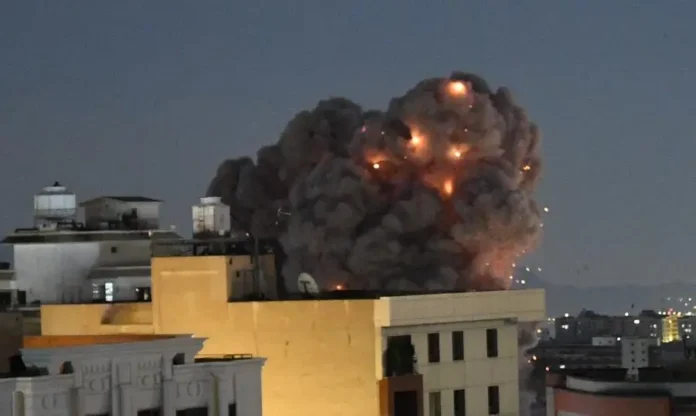
Tehran/Washington/Seoul, Aug. 19: Tensions across West Asia and the wider Asia-Pacific region appeared to deepen on Wednesday as Iran rejected allegations that it had launched ballistic missiles towards the United Arab Emirates, the UAE suspended trade and financial transactions with Tehran, and US President Donald Trump reportedly ordered his negotiating team to halt conversations with Iran.
The developments unfolded alongside another significant strategic decision in East Asia, where South Korea and the United States announced that they would substantially scale down their annual Ulchi Freedom Shield joint military exercise following Trump’s request.
Iran Rejects Missile Allegations
Iranian Foreign Ministry spokesperson Esmaeil Baghaei rejected the UAE’s claim that two ballistic missiles had been launched from Iran towards the country.
The UAE Ministry of Defence had said that two missiles were detected on Tuesday. According to the ministry, the first missile fell outside the UAE’s territorial waters, while the second landed within them. The missiles were said to have been targeting maritime traffic.
No casualties or damage were reported.
Iran, however, categorically denied the allegation. Baghaei said the accusations ran contrary to the principles of good neighbourliness and could undermine efforts to build trust among countries in the region.
He urged regional nations to refrain from making what Iran described as baseless accusations, particularly at a time when tensions in West Asia were already high.
The UAE said it remained on high alert and was prepared to respond to any threat affecting its security, sovereignty or stability.
The diplomatic fallout escalated further when the UAE Ministry of Foreign Affairs announced the suspension of all trade, commercial exchanges and financial transactions with Iran until further notice.
The decision was described as a response to escalating tensions affecting regional and international peace and security, although the UAE also reiterated its commitment to dialogue, cooperation and regional integration.
Trump Reportedly Halts Engagement with Iran
The developments came as the future of US-Iran negotiations became increasingly uncertain.
According to a CNN report cited in the IANS copy, Trump instructed his negotiating team—including Vice President JD Vance and envoys Steve Witkoff and Jared Kushner—not to engage with Tehran for the time being.
The report said Trump was dissatisfied with Iran’s response to US demands and wanted to wait until Tehran showed renewed willingness to reach an agreement before resuming engagement.
Trump later stated on social media that there were no talks or conversations currently taking place or scheduled with Iran.
The United States and Iran remain divided over the situation in the Strait of Hormuz and the conditions for ending the ongoing conflict. The uncertainty has increased after a 60-day negotiating period established under a memorandum of understanding ended on Monday.
Washington is also reportedly shifting towards a strategy of sustained financial pressure on Tehran rather than further military action.
US Treasury Secretary Scott Bessent said the administration was stepping up its campaign against Iranian financial networks, including bank accounts, cryptocurrency wallets and assets.
Trump also maintained that the naval blockade remained in force while claiming that the Strait of Hormuz was open and operating.
US and South Korea Scale Down Military Drills
Meanwhile, in East Asia, South Korea and the United States announced a significant reduction in the scale of the annual Ulchi Freedom Shield exercise.
The 11-day exercise, originally scheduled to run from August 17 to August 27, will now conclude on Friday.
The decision followed Trump’s request to scale down the drills, citing their cost and his view that they could send what he described as an inappropriate and hostile signal to North Korea.
The Pentagon said the exercise had been substantially reduced, with some live-training events cancelled, others converted into simulations and field manoeuvres scaled back.
However, US officials maintained that the changes would not weaken military preparedness or affect essential training objectives.
South Korean Defence Minister Ahn Gyu-back said the allies appeared to be moving towards cancelling the second phase of the exercise.
Ulchi Freedom Shield is one of the two major annual combined military exercises conducted by South Korea and the United States to prepare for potential contingencies involving North Korea.
The exercise primarily involves simulation-based command post operations but also includes field manoeuvres across land, sea and air.
The allies had originally planned 14 battalion-level or larger field exercises this year. These activities are now being reduced, with discussions continuing over whether some drills could be held separately, conducted independently by South Korea or postponed.
The reduction has raised questions about South Korea’s efforts to regain wartime operational control, or OPCON, from Washington. Seoul has been seeking to accelerate the transition process, although Defence Minister Ahn said the scaled-down exercise would not affect the assessment of South Korea’s readiness.
The developments across West Asia and East Asia underline a period of heightened geopolitical uncertainty, with tensions involving Iran and the UAE, the suspension of US-Iran engagement, and changes in the US military posture with South Korea all emerging within a short span.
While Iran and the UAE remain divided over the missile allegations, Washington’s next steps towards Tehran remain uncertain. At the same time, the decision to scale back the US-South Korea exercise has added to speculation about the possibility of renewed engagement between Trump and North Korean leader Kim Jong-un.