New Delhi, April 27: India has secured full tariff-free access for its exports to New Zealand under a newly signed Free Trade Agreement that also includes major investment commitments, expanded mobility provisions, and sectoral cooperation across manufacturing, services, and healthcare.
The agreement was formally signed on Monday in New Delhi in the presence of Commerce Minister Piyush Goyal and New Zealand Trade Minister Todd McClay. The deal marks a significant expansion of bilateral economic engagement and was concluded within nine months of negotiations beginning on March 16, 2025.
Under the agreement, New Zealand will eliminate tariffs on 100 per cent of tariff lines covering Indian exports. This removes the existing average tariff of around 10 per cent applied on nearly 450 product categories, including textiles and apparel, leather goods, headgear, ceramics, carpets, automobiles, and auto components.

On the import side, India has agreed to either reduce or eliminate tariffs on 95 per cent of goods from New Zealand, while retaining protection for sensitive sectors, including all dairy products such as milk, cream, whey, yoghurt, and cheese, along with select agricultural items.
The agreement also includes a significant investment commitment of $20 billion from New Zealand into India over a 15-year period, reflecting long-term economic engagement between the two countries.
A key component of the FTA is the mobility framework for professionals and students. For the first time, New Zealand has signed a dedicated annex on student mobility and post-study work rights with any country. Indian students will be permitted to work up to 20 hours per week during studies, along with extended post-study work visa options.
The agreement also provides a quota of 5,000 visas for skilled Indian professionals for stays of up to three years. This category includes sectors such as AYUSH practitioners, yoga instructors, chefs, music teachers, as well as professionals in IT, engineering, healthcare, education, and construction.
Additionally, under a Working Holiday Visa programme, 1,000 young Indians will be allowed multiple entries into New Zealand annually for up to 12 months.
In the manufacturing and export sector, the agreement is expected to benefit India’s leather industry, projected to reach $50 billion by 2030. Officials highlighted complementarity between New Zealand’s raw leather resources and India’s manufacturing base. Leather and footwear tariffs, previously around five per cent, will now be reduced to zero, providing exporters a competitive advantage.

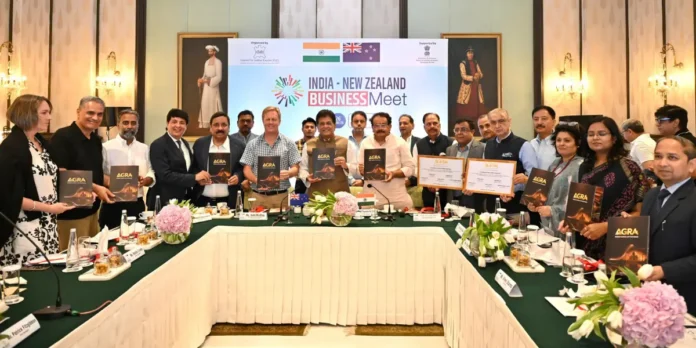
Agra, a major leather production hub accounting for about 75 per cent of India’s footwear output and holding a Geographical Indication tag, has been identified as a potential global sourcing centre under the One District One Product initiative.
In pharmaceuticals and medical devices, the FTA introduces faster regulatory approvals through acceptance of GMP and GCP inspection reports from recognised international regulators. It also establishes a dedicated chapter on health and traditional medicine, including recognition of AYUSH systems.
The agreement is expected to deepen trade ties while expanding India’s access to high-value export markets and skilled mobility frameworks.