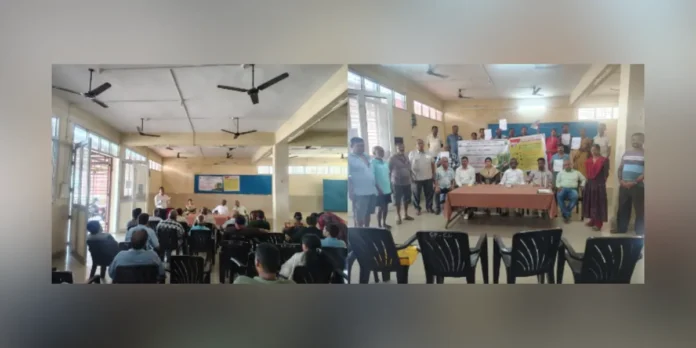
Sri Vijaya Puram, April 27: Concerns over soil degradation and the environmental impact of excessive fertilizer use were brought into focus during an awareness programme held in Chouldari Panchayat, where farmers were trained on sustainable soil and nutrient management practices.
The programme, conducted on April 24, 2026, in South Andaman District, aimed to equip farmers with practical knowledge on efficient fertilizer use while promoting eco-friendly agricultural approaches to enhance soil productivity. A total of 25 farmers participated in the session.
Scientists from ICAR–Central Island Agricultural Research Institute, Sri Vijaya Puram, led the discussions, addressing key challenges faced by farmers in maintaining soil health and managing inputs effectively. The session emphasised the need for balanced nutrient application to avoid long-term damage to soil quality.

During the interaction, Principal Scientist P. K. Singh highlighted the importance of judicious fertilizer use, stressing balanced nutrient management and the adoption of crop rotation practices to sustain productivity. He underscored that improper application of fertilizers can degrade soil health and reduce yield efficiency over time.
Senior Scientist Pooja Bohra focused on alternative organic inputs, including green manure and vermicompost, particularly in horticulture. She explained how such inputs improve soil structure, enhance fertility, and reduce dependence on chemical fertilizers.
The environmental consequences of fertilizer misuse were also discussed. Scientist Chittaranjan Raul explained how fertilizer runoff into water bodies can lead to nutrient enrichment, triggering algal blooms that disrupt aquatic ecosystems and degrade water quality in ponds.
Further, Senior Scientist Perumal P. highlighted the potential of cattle waste in producing organic manure. He encouraged farmers to adopt integrated farming practices that combine crop production with livestock management to ensure sustainable and resource-efficient agriculture.

The programme concluded with an interactive session, allowing farmers to raise queries and share field-level experiences. The discussions helped clarify practical concerns related to soil management and input usage.
Officials noted that the initiative aimed to strengthen farmers’ understanding of sustainable agricultural practices while addressing environmental risks associated with conventional farming methods.
The awareness drive forms part of ongoing efforts to promote environmentally responsible agriculture in the region by improving soil health management and encouraging the adoption of organic and integrated farming systems.