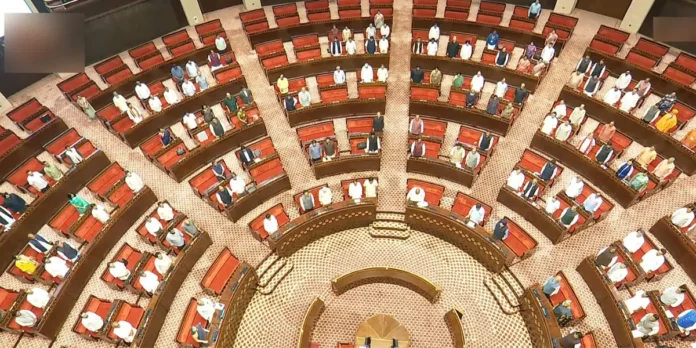
New Delhi, April 27: A major political shift reshaped representation in the Rajya Sabha after seven members of the Aam Aadmi Party joined the Bharatiya Janata Party through a merger provision under constitutional rules, altering the balance of strength in the Upper House.
The Rajya Sabha on Monday issued a revised list of party positions following the change, which increased the Bharatiya Janata Party’s strength in the House from 107 to 113 members. The Aam Aadmi Party’s representation has now been reduced to three members.
The members who shifted their affiliation include Raghav Chadha, Swati Maliwal, Harbhajan Singh, Sandeep Pathak, Ashok Mittal, Rajinder Gupta, and Vikram Sahni. The group announced last week that they had decided to leave the Aam Aadmi Party and align with the Bharatiya Janata Party.

With this move, the BJP has further consolidated its position in the Upper House of Parliament. The remaining Aam Aadmi Party members in the Rajya Sabha are Sanjay Singh, Narain Dass Gupta, and Sant Balbir Singh.
The seven members together accounted for a two-thirds majority of the party’s representation in the Rajya Sabha. The shift was executed under provisions of the Tenth Schedule of the Constitution, introduced through the 52nd Amendment in 1985, which allows mergers when at least two-thirds of a party’s members agree, without attracting disqualification.
The defecting members cited the merger clause to justify their decision, which legally permits such a political realignment without triggering anti-defection penalties for either the departing or remaining members.
Earlier in the day, Raghav Chadha issued a public explanation for his decision through a social media video, stating that he had joined the Bharatiya Janata Party after concluding that the Aam Aadmi Party had undergone significant internal changes over time.
Chadha said he had devoted 15 years to the Aam Aadmi Party since its formation, including leaving his profession as a practising Chartered Accountant to join politics as a founding member. He described his association with the party as spanning his early political career and formative years in public life.
In his statement, he alleged that the party’s internal environment had become restrictive, claiming difficulties in carrying out political work and participating in parliamentary proceedings. He further stated that decision-making within the organisation had become concentrated among a limited group of individuals.

Chadha also expressed that over time he felt disconnected from the organisation’s functioning and was faced with limited options, including exiting politics, staying within the party to attempt internal reform, or joining another platform to continue political work.
He stated that the decision to move to the Bharatiya Janata Party was taken collectively by seven Members of Parliament who decided to leave the Aam Aadmi Party together.
The development marks a significant shift in parliamentary representation dynamics in the Rajya Sabha, triggered by the use of the constitutional merger provision under anti-defection rules.