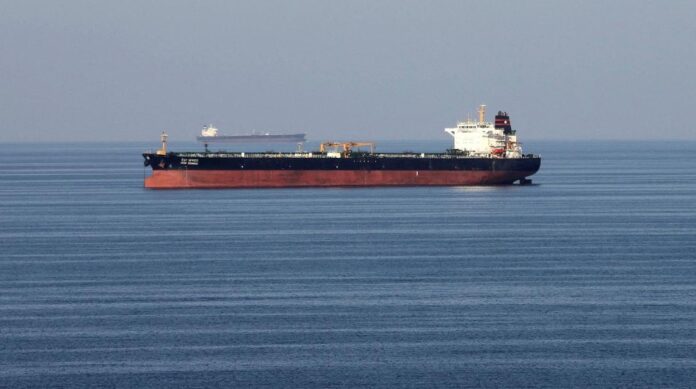
New York, May 29: An India-bound crude oil tanker has successfully crossed the strategically critical Strait of Hormuz amid continuing geopolitical tensions in West Asia, offering temporary relief to energy markets and shipping operators closely monitoring disruptions in the region.
According to maritime tracking reports, the tanker Nissos Keros is currently sailing through the northern Arabian Sea and is expected to reach Visakhapatnam on June 3. The vessel is reportedly carrying crude oil cargo intended for Indian refining operations.
The Marshall Islands-flagged vessel had departed from Sharjah on May 21 and was later tracked moving west of India’s coastline after successfully transiting through the Strait of Hormuz, one of the world’s most strategically important maritime chokepoints.
Shipping data cited by international media agencies indicated that the vessel is among a limited number of tankers that have recently managed to exit the Gulf amid heightened military tensions and severe restrictions on commercial maritime movement.

The Strait of Hormuz, located between Iran and Oman, handles nearly 20 per cent of global oil and gas trade. Since the escalation of conflict involving Iran, the United States and Israel earlier this year, maritime activity in the region has sharply declined, triggering fears of a prolonged global energy disruption.
Iran’s state news agency IRNA reported that the Islamic Revolutionary Guard Corps (IRGC) Navy permitted 23 commercial vessels, including oil tankers and container ships, to pass through the Strait within a 24-hour period following coordination with Iranian authorities.
However, uncertainty continues over Iran’s proposed regulation of maritime transit through the region. Tehran had earlier announced plans to establish a Persian Gulf Strait Authority aimed at controlling and regulating shipping movement through the waterway.
The development has sparked international concern, particularly after reports that Iran intended to impose transit-related charges on vessels crossing the Strait. The United Nations has maintained that international waters cannot be subjected to unilateral navigation fees.
The United States has repeatedly demanded restoration of unrestricted navigation through the Strait, with the issue emerging as one of the key sticking points in ongoing diplomatic negotiations linked to the broader regional conflict.
US President Donald Trump recently stated that the Strait “is going to be open to everybody,” while warning against any arrangements that could restrict free movement of commercial shipping.
International maritime agencies have reported that shipping traffic through the region remains significantly lower than normal levels. According to International Maritime Organisation Secretary-General Arsenio Dominguez, nearly 1,500 vessels are believed to be stranded in or around the Persian Gulf due to ongoing instability.
Industry analysts say India remains particularly vulnerable to disruptions in the Strait because of its heavy dependence on crude oil and gas imports from Gulf nations.

In recent months, several India-bound LPG and LNG carriers have reportedly crossed the Strait under close monitoring amid fears of attacks, detentions or mining activity in the region.
The Nissos Keros, built by Hyundai, is a Very Large Crude Carrier (VLCC) with a carrying capacity of more than 318,000 tonnes, according to maritime databases. The vessel is operated by Kyklades Maritime Corporation.
Experts say successful passage of crude carriers through the Strait remains critical for stabilizing global oil supplies and preventing further escalation in fuel prices across international markets.
The continued movement of India-bound vessels through the region is also being closely watched by shipping authorities, energy companies and policymakers amid concerns that prolonged instability could affect fuel imports, freight costs and broader economic activity.