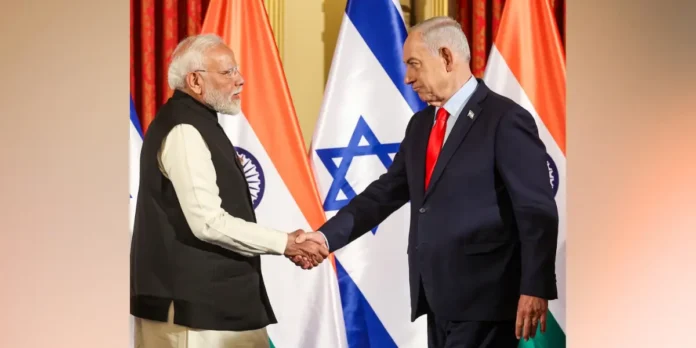
Sri Vijaya Puram, August 18: India’s expanding role in a changing Middle East is increasingly being viewed through the combined lens of economic connectivity, technology partnerships and regional security, with a recent report highlighting a wider strategic geography stretching from West Asia to the Andaman and Nicobar Islands and the Strait of Malacca. The report said the growing prominence of the India-Israel-UAE-US grouping, or I2U2, alongside the India-Middle East-Europe Economic Corridor (IMEC), reflects a convergence between economic integration and regional security.
The analysis, published by The Jerusalem Post and reported by IANS, said India has emerged as a country capable of engaging with the United States, Israel, the UAE and increasingly Saudi Arabia while maintaining engagement across political divides without requiring ideological alignment. It linked this role to Washington’s search for dependable partners to help preserve regional stability as it seeks to reduce its military involvement in the region.
According to the report, economic corridors, technology cooperation, resilient supply chains and strategic connectivity are becoming increasingly important in shaping the Middle East. It said India’s position provides a potential link between Israeli technological capabilities, Gulf investment and American strategic interests.

The report also noted that India-Israel ties have expanded significantly beyond defence procurement over the past three decades. Areas of cooperation now include counterterrorism, intelligence sharing, cybersecurity, agriculture, water management, artificial intelligence, space technology, healthcare innovation and start-up ecosystems.
The UAE and Saudi Arabia, meanwhile, are increasingly viewing India as a long-term strategic partner rather than only an important energy market, the report said. It cited India’s large and growing economy, investment opportunities, role in food security and pool of skilled professionals contributing to Gulf economies as areas of economic complementarity. It also pointed to Saudi Arabia’s Vision 2030 and Abu Dhabi’s ambitions in advanced manufacturing and technology.
The analysis said a stronger India-US relationship could reinforce initiatives such as I2U2 and IMEC, while India’s growing ties with Saudi Arabia and the UAE could create additional diplomatic channels for broader regional cooperation involving Israel.
The report’s focus also extended eastward to India’s Andaman and Nicobar Islands, identifying the archipelago as part of the country’s broader strategic maritime outlook. It said India is investing heavily in the islands as a strategic maritime hub overlooking the Strait of Malacca.

This eastward dimension places the Andaman and Nicobar Islands within a wider connectivity narrative alongside IMEC. The report linked the two to what it described as a broader vision of connecting the Mediterranean with Southeast Asia through secure and resilient trade corridors.
The reference to the Strait of Malacca adds a distinct maritime dimension to the report’s assessment of India’s strategic position. The waterway connects the Indian Ocean region with the Pacific and remains central to international shipping and regional connectivity.
For the Andaman and Nicobar Islands, the report’s emphasis on their location near the Strait of Malacca places the archipelago within a larger strategic conversation that connects India’s western economic and diplomatic engagements with its eastern maritime geography.