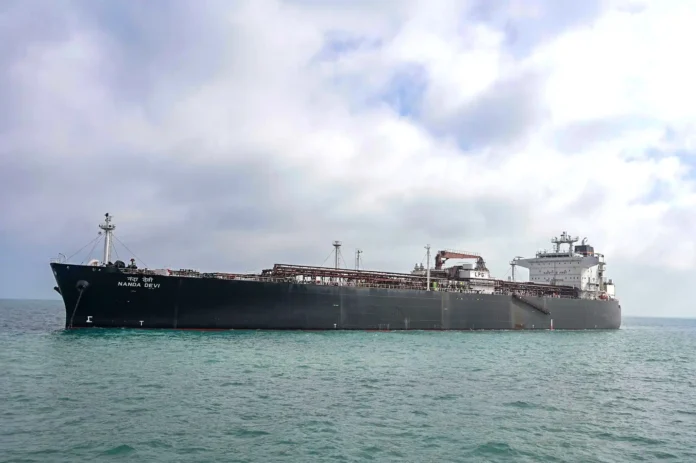
Sri Vijaya Puram, May 22: Growing uncertainty around major maritime chokepoints such as the Strait of Hormuz and the Strait of Malacca is emerging as a major strategic and economic concern for India, with a new report warning that critical global trade passages are increasingly being viewed as assets that can be regulated, priced or politically leveraged.
According to an article published by India Narrative, recent developments involving Iran and Indonesia have highlighted how nations controlling narrow maritime corridors may seek to monetise or regulate passage through these routes, creating new challenges for global trade flows and energy security.
The report notes that Iran has already demonstrated its ability to exploit its geographical advantage around the Strait of Hormuz by charging fees on ships transiting through the waterway. Indonesia has also reportedly indicated that it may contemplate similar measures concerning the Strait of Malacca, one of the world’s busiest shipping corridors.

For India, the implications are particularly significant due to its dependence on these maritime routes for both trade and energy imports. The article states that nearly 50 per cent of India’s crude oil imports and almost 90 per cent of its LPG and LNG imports pass through the Strait of Hormuz, making it the country’s largest energy vulnerability.
Following disruptions linked to Hormuz, India has reportedly begun rerouting nearly 70 per cent of its crude imports through longer alternative sea routes including the Arctic and Baltic corridors. This includes shipments sourced from West Africa and Russia. However, the report argues that relying on such extended maritime routes may prove economically unsustainable over time due to higher transportation costs and logistical challenges.
The Strait of Malacca, meanwhile, remains central to India’s broader trade network. Although India’s crude oil imports are less dependent on Malacca, more than one-third of the country’s global trade, particularly commerce with Southeast Asian nations, moves through the narrow passage.
The article describes Malacca as India’s “trade artery” while calling Hormuz its “energy lifeline”, underscoring the strategic importance of both routes to the Indian economy.
Experts cited in the report warn that if transit through such chokepoints becomes subject to taxation, regulation or geopolitical bargaining, the impact on economies dependent on maritime trade could be systemic rather than marginal. Increased unpredictability in shipping routes could drive up trade costs and expose countries to political decisions beyond their direct control.
The report further states that India has already begun strengthening resilience measures through expansion of port infrastructure, growth in domestic refining capacity and creation of strategic petroleum reserves.
The strategic role of the Andaman and Nicobar Islands also finds mention in the article, particularly in relation to the proposed trans-shipment hub in Great Nicobar Island. Their location near the western approaches of the Strait of Malacca is viewed as offering India enhanced monitoring capability over maritime traffic and a stronger presence in a geopolitically sensitive region.
The report suggests that India could reduce dependence on vulnerable chokepoints by diversifying oil sourcing from regions such as the West, Russia and Africa while also investing in overland and multi-modal trade corridors.
At the same time, it argues that long-term resilience lies in reducing the country’s dependence on fossil fuel imports routed through extended maritime supply chains. Expansion of renewable energy generation, electrification of transport systems and growth of non-fossil fuel energy capacity are identified as measures that could gradually reduce India’s exposure to maritime disruptions.

The article also emphasises the importance of strengthening strategic reserves and market buffer mechanisms to cushion against volatility arising from disruptions in global transit routes.
While Indonesia’s position regarding the Strait of Malacca may not immediately translate into policy changes, the report notes that it introduces a fresh layer of strategic uncertainty in the Indo-Pacific region.
The analysis concludes that India’s response will require a broader integration of maritime strategy, energy planning and geopolitical assessment as the global trade environment becomes increasingly shaped by control over critical sea corridors.