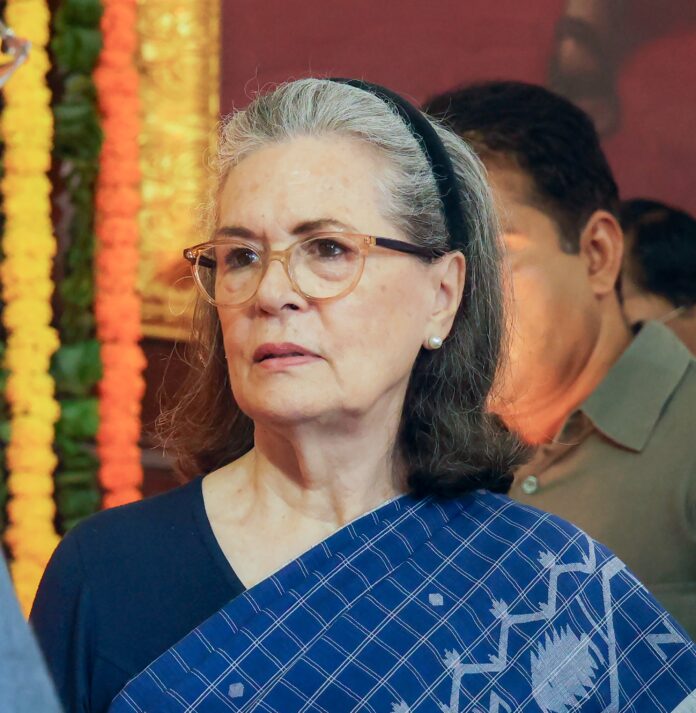
The Union government’s ambitious ₹2.72 lakh crore Great Nicobar Project has come under strong criticism from Congress Parliamentary Party Chairperson Sonia Gandhi, who has termed it a “grave misadventure” that threatens both the survival of indigenous tribes and one of India’s most fragile ecosystems.
In an opinion piece published on Monday, Gandhi argued that the mega-infrastructure project undermines constitutional safeguards, disregards due process, and risks permanent damage to the environment of the southernmost island of the Andaman and Nicobar archipelago. She warned that “the collective conscience cannot and must not stay silent when the very survival of the Shompen and Nicobarese tribes is at risk.”
The project, spread across 160 square kilometres, includes plans for a transhipment port, an international airport, a township, and a power plant. Gandhi alleged that the development would displace the Nicobarese, already reeling from the 2004 tsunami, and threaten the cultural integrity of the Shompen, a particularly vulnerable tribal group dependent on forests for their livelihood.
Citing constitutional provisions, she stated that the government had ignored its obligation to consult the National Commission for Scheduled Tribes under Article 338-A, as well as the Tribal Council of Great Nicobar and Little Nicobar Islands. According to her, even the Council’s “no-objection” letter was rushed and later revoked, reflecting inadequate consent.
She further claimed that the Social Impact Assessment under the 2013 Land Acquisition Act failed to account for the two tribal groups as stakeholders, and that the Forest Rights Act, which empowers the Shompen to manage their forests, was bypassed.
Environmental concerns form a major part of her critique. Gandhi noted that the Ministry of Environment, Forest and Climate Change had estimated that 8.5 lakh trees would be cut for the project, though independent estimates placed the number between 32 lakh and 58 lakh. She also raised objections to the compensatory afforestation plan, which controversially designates land in Haryana, far from the island’s unique ecology. Part of this land, she said, had already been auctioned for mining.
Adding to the ecological alarm, Gandhi pointed out that part of the proposed port site falls under CRZ-1A, a category that prohibits construction in areas critical for coral reefs and turtle nesting. She said a National Green Tribunal order confirming this had been overlooked, and accused a high-powered committee of manipulating evidence.

Biodiversity studies carried out for the project were also questioned. Gandhi argued that the survey of turtle nesting sites was conducted in the off-season, while the use of drones to assess dugongs was unsuitable for deeper waters. She also suggested that institutions involved in environmental assessments were placed under duress.
Highlighting the island’s seismic vulnerability, she cautioned that building large-scale infrastructure in an earthquake-prone zone could endanger not only the ecology but also the viability of the massive investment.
The criticism aligns with longstanding concerns raised by environmentalists, tribal welfare advocates, and researchers who have repeatedly flagged the risks associated with the project. Proponents, however, argue that the plan will boost India’s strategic position in the Indian Ocean, strengthen connectivity, and bring development to the remote island.
Despite the government’s insistence on moving forward, Gandhi urged a reconsideration, stressing that protecting indigenous communities and fragile ecosystems must take precedence over large-scale development. “Our commitment to future generations cannot permit this large-scale destruction of a most unique ecosystem,” she wrote, adding that the project risks becoming an ecological and social disaster.
The debate around the Great Nicobar Project is likely to intensify as questions mount over its environmental clearances, legal compliance, and long-term sustainability. For now, the voices of opposition, both political and civil society, are becoming sharper in warning of irreversible consequences.