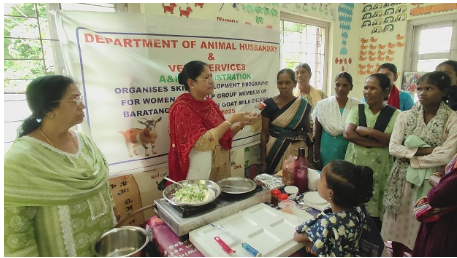
A unique training programme in Baratang has introduced tribal women to goat milk cheese making, aiming to strengthen both livelihoods and conservation. Organised by the Department of Animal Husbandry and Veterinary Services, the workshop focused on the Andaman goat, a hardy local breed valued for its adaptability, and the potential of its milk in producing nutritious dairy products.
The session, conducted for the Sooraj Self-Help Group at Roglachang, was led by senior veterinary officers Dr. Inderjit Kaur and Dr. Sabitawati. The officers guided participants through the process of cheese production, highlighting techniques that could be adapted at the household and community level. The training not only introduced a value-added product but also showcased how livestock-based enterprises can diversify income sources in rural areas.

The Andaman goat, central to the initiative, has long been recognised for its resilience in local climatic conditions. By encouraging its rearing and promoting the use of its milk, officials said the programme contributes to conserving the germplasm of the breed while creating economic opportunities. Trainers highlighted the nutritional benefits of goat milk, which is easier to digest than cow milk and is recommended for addressing certain health concerns.
The workshop emphasised skill development as a pathway to empowerment. For the women of the Sooraj Self-Help Group, the training offered an opportunity to acquire knowledge that can be translated into entrepreneurship. By learning cheese-making techniques, participants were encouraged to explore small-scale production for both local consumption and niche markets.
The broader vision behind the training is to integrate conservation, livelihood and nutrition goals. Goat rearing has traditionally been part of rural life in the Islands, but structured initiatives to add value to its products have been limited. The introduction of cheese-making is seen as a step towards modernising traditional practices without undermining ecological sustainability.
Officials pointed out that promoting goat milk cheese could provide multiple benefits. It diversifies the dietary options available to families, potentially improving nutrition. It also creates an avenue for income generation, particularly for women who play a significant role in animal care and household economics. By positioning women as producers, the training contributes to greater economic independence within the community.
The active participation of the Sooraj SHG members reflected both curiosity and commitment. Participants engaged in practical demonstrations, learning how to balance milk quality, temperature and techniques to produce consistent results. Trainers noted that even at a small scale, cheese-making can supplement household income if linked with local markets, festivals and eco-tourism activities.
By focusing on local breeds, the administration aims to preserve biodiversity while creating rural livelihoods. Officials said the project was part of a larger vision of empowering marginalised groups through skill-based training and community engagement.
The Andaman goat, while adapted to local conditions, requires systematic support to remain viable against pressures of crossbreeding and declining interest in traditional rearing. By making its milk more valuable, the programme creates incentives for continued conservation.
The cheese-making workshop concluded with optimism among participants and trainers alike. For the women, it marked the beginning of a possible new venture. For the administration, it reaffirmed the role of targeted training programmes in achieving social and economic objectives.
As the Islands explore ways to balance conservation with development, the Baratang goat cheese training highlights how simple, skill-based interventions can generate lasting impact. By empowering tribal women to turn a local resource into a marketable product, the initiative offered both practical skills and a vision of sustainable livelihoods rooted in tradition.