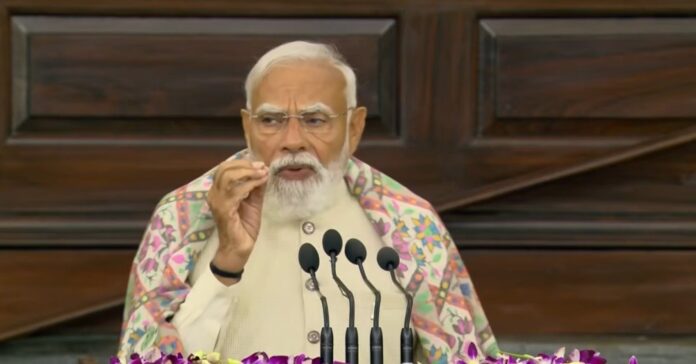
Delhi, May 28: Prime Minister Narendra Modi on Thursday paid tribute to freedom fighter Vinayak Damodar Savarkar on his birth anniversary, remembering his courage, patriotism and contributions to India’s freedom movement while also recalling his imprisonment at the historic Cellular Jail in the Andaman & Nicobar Islands.
Taking to social media platform X on the occasion of Savarkar’s Jayanti, the Prime Minister said that Veer Savarkar’s courage and patriotism would continue to inspire generations.
“Remembering Veer Savarkar on his Jayanti. His courage and patriotism will always inspire people. His intellect and emphasis on social reform are also noteworthy,” PM Modi wrote.
The Prime Minister also shared a video message in which he described Savarkar as a personality marked by sacrifice, courage and determination.

“Today, on May 28, is the birth anniversary of freedom fighter Veer Savarkar. His sacrifice, courage and determination continue to inspire us,” PM Modi said in the video message.
Highlighting Savarkar’s multifaceted personality, the Prime Minister stated that he was not only a revolutionary freedom fighter but also a poet, thinker and social reformer who advocated social harmony and unity.
“Savarkar’s personality was full of unique qualities. He was a worshipper of both weapons and scriptures. He was also a powerful poet and social reformer who emphasised harmony and unity,” he added.
The Prime Minister also made a special reference to the Cellular Jail in the Andaman Islands, where Savarkar served a significant part of his imprisonment under British colonial rule.
“I cannot forget the day when I visited the jail in Andaman where Veer Savarkar served his Kalapani sentence,” PM Modi said, recalling the historical significance of the prison associated with India’s freedom struggle.
The Cellular Jail, commonly referred to as ‘Kala Pani’, remains one of the most prominent historical landmarks in the Andaman & Nicobar Islands and is closely associated with the sacrifices made by freedom fighters during British rule. Savarkar was imprisoned there after being sentenced by the British government for revolutionary activities linked to India’s independence movement.
The Prime Minister further described Savarkar as fearless and deeply self-respecting, stating that his personality did not conform to a mentality of subjugation.
Born on May 28, 1883, in Nashik, Maharashtra, Vinayak Damodar Savarkar emerged as one of the influential figures in India’s nationalist movement during the early twentieth century. He was a freedom fighter, lawyer, politician and writer and is widely known for coining the term “Hindutva”.
Savarkar was also associated with the Hindu Mahasabha and played a major role in nationalist political discourse during his time.

His involvement in the freedom movement reportedly began during his student years and continued during his education at Fergusson College. He was strongly influenced by nationalist leader Bal Gangadhar Tilak and later became active in revolutionary circles while studying law in the United Kingdom.
During his stay abroad, Savarkar was associated with groups such as India House and the Free India Society, which advocated revolutionary methods for India’s independence from British rule.
He also authored several books and writings related to nationalism and India’s freedom movement, including “The Indian War of Independence”, a work based on the 1857 uprising, which was later banned by British colonial authorities.
The Prime Minister’s remarks drew attention once again to the enduring historical connection between Veer Savarkar and the Andaman & Nicobar Islands, particularly the Cellular Jail, which today stands as a national memorial commemorating the sacrifices of freedom fighters.