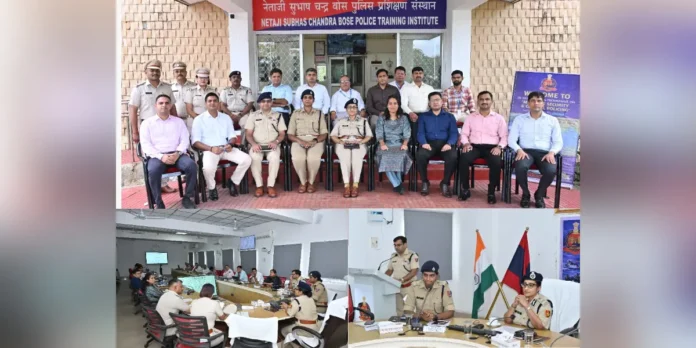
Sri Vijaya Puram, May 19: A five-day national-level training programme on maritime security and coastal policing began in the Andaman & Nicobar Islands on May 18, bringing together officers from across India to address growing challenges in maritime surveillance and coastal security.
The programme, being conducted from May 18 to 22 at the Netaji Subhas Chandra Bose Police Training Institute, aims to strengthen operational capabilities and inter-agency coordination among IPS and gazetted officers representing states, Union Territories, and allied agencies.
Organised as the second edition of its kind, the training has been redesigned to be more practical and outcome-oriented, incorporating feedback from participants of the previous programme. It focuses on key aspects such as maritime security architecture, coastal surveillance systems, and emerging threats in the maritime domain.

The programme was inaugurated by Sindhu Pillai, Additional Director General of Police, Andaman & Nicobar Islands, in the presence of senior police officials and representatives from participating agencies. Addressing the gathering, she underlined the increasing significance of maritime security in the evolving security landscape and welcomed officers from both mainland India and the islands.
She said the initiative has been developed under the guidance of Director General of Police Hargobinder Singh Dhaliwal, with the objective of enhancing decision-making and field-level operational preparedness of officers engaged in coastal policing. She also acknowledged the role of Uma Shankar, Principal of the institute, for organising the programme and coordinating the sessions.
Participants in the programme include officers from Haryana, Gujarat, Maharashtra, New Delhi, and Tamil Nadu, along with representatives from the CISF, IRBn, Fisheries Department, Port Management Board, and various wings of the Andaman & Nicobar Police and administration. The platform is expected to facilitate exchange of best practices and improve coordination among multiple agencies involved in maritime security.
Highlighting the strategic importance of the islands, officials noted that the Andaman & Nicobar region serves as a critical frontline in India’s eastern maritime sector due to its proximity to key international shipping routes and vast maritime boundaries.

The training programme also addresses a range of emerging threats, including illegal fishing, foreign poaching, smuggling, narcotics trafficking, arms movement, and infiltration. Officials emphasised the need for coordinated, intelligence-driven, and technology-supported responses to tackle these challenges effectively.
The curriculum includes detailed sessions on maritime laws, coastal security frameworks, surveillance mechanisms, and operational roles of agencies such as the Indian Coast Guard. It also features field visits, live demonstrations of coastal patrolling, and anti-poaching operations to provide participants with hands-on experience.
Officials said the initiative is expected to enhance preparedness and strengthen India’s coastal security framework by equipping officers with both theoretical knowledge and practical exposure to real-world maritime challenges.