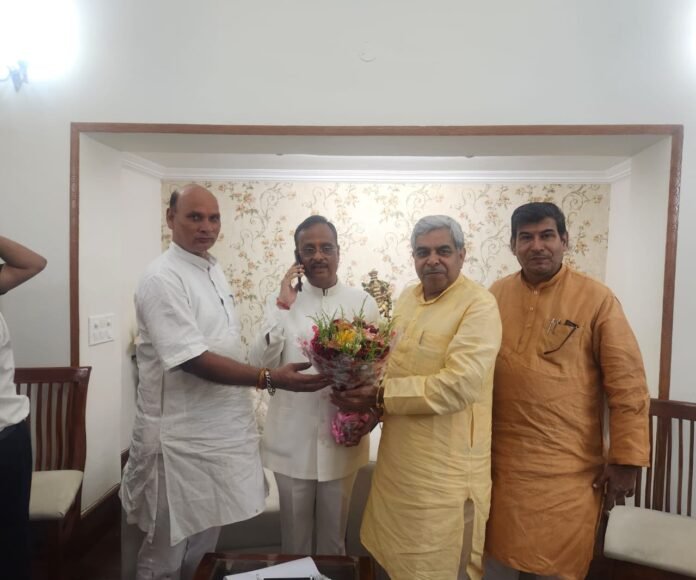
Sri Vijaya Puram, September 16: In the days before Dr Dinesh Sharma left Uttar Pradesh to take charge as Lieutenant Governor of the Andaman and Nicobar Islands, there was a steady stream of people coming to meet him.
Supporters and well-wishers gathered around the former Uttar Pradesh Deputy Chief Minister as he prepared for a very different assignment, thousands of kilometres away from the state where he spent much of his political career. Reports from Uttar Pradesh said visitors continued to arrive at his residence following the announcement of his appointment.
On September 15, Sharma formally took oath as the 14th Lieutenant Governor of the Andaman and Nicobar Islands at Lok Niwas in Sri Vijaya Puram. Chief Justice of the Calcutta High Court Justice Ravindra Vithalrao Ghuge administered the oath of office and secrecy. Sharma succeeds Admiral D.K. Joshi (Retd), who had been Lieutenant Governor since October 2017.
The President had announced Sharma’s appointment on September 5, with the appointment taking effect from the day he assumed office.
A long innings in Uttar Pradesh
Sharma arrives in the Islands after a political and public career spanning municipal administration, the Uttar Pradesh government, the BJP organisation and Parliament.
An academic before becoming a full-time political figure, Sharma was a professor of commerce at the University of Lucknow and holds a PhD. His first major elected administrative position was as Mayor of Lucknow. He was elected in 2006 and again in 2012, remaining mayor until March 2017.
But Sharma’s political career extended well beyond the Uttar Pradesh capital.
He served as national vice-president of the Bharatiya Janata Party and as the party’s in-charge for Gujarat between 2014 and 2018. He also handled the BJP’s national membership campaign and earlier served as president of the Bharatiya Janata Yuva Morcha in Uttar Pradesh.
His biggest role in government came in 2017, when he became one of the two Deputy Chief Ministers in the first Yogi Adityanath government. During his five-year tenure, Sharma handled portfolios including secondary education, higher education, science and technology, and electronics and information technology.
After his stint in the Uttar Pradesh government ended in 2022, Sharma subsequently moved to Parliament. In September 2023, he was elected to the Rajya Sabha from Uttar Pradesh and served in the Upper House for nearly three years. He resigned his Rajya Sabha seat on September 11, just days before taking over as Lieutenant Governor.
It is this mix of electoral politics, administration, party organisation and parliamentary experience that Sharma now brings to the Islands.
A very different assignment
Andaman and Nicobar, however, will present a very different set of challenges.
Connectivity remains at the heart of everyday life here. High airfares, the availability of flights, inter-island shipping and the cost of transporting essential commodities affect Islanders in ways that are difficult to appreciate from the mainland.
Healthcare, particularly outside Sri Vijaya Puram, remains another concern. So do employment opportunities for young Islanders, the quality of public infrastructure and the need to create a stronger private economy.
Tourism offers enormous potential, but exploiting it will require better connectivity, more quality accommodation and infrastructure while protecting the fragile ecology that makes the Islands unique in the first place.
Then there is Great Nicobar, where the proposed mega infrastructure project has put the Islands at the intersection of India’s economic, environmental and strategic priorities.
For Sharma, therefore, the move from Uttar Pradesh to Andaman and Nicobar is more than a change of office.
He comes from the world of mass politics, where meeting people and responding to constituents has been part of his working life for decades. The expectation in the Islands will be that some of that accessibility travels with him.
For ordinary Islanders, the test will ultimately be practical: whether the administration listens, whether long-pending problems move faster and whether development reaches people living far beyond Sri Vijaya Puram.
After decades in Uttar Pradesh politics and a stint in Parliament, Sharma has begun an altogether different chapter – this time at the helm of one of India’s smallest, most geographically challenging and strategically important Union Territories.