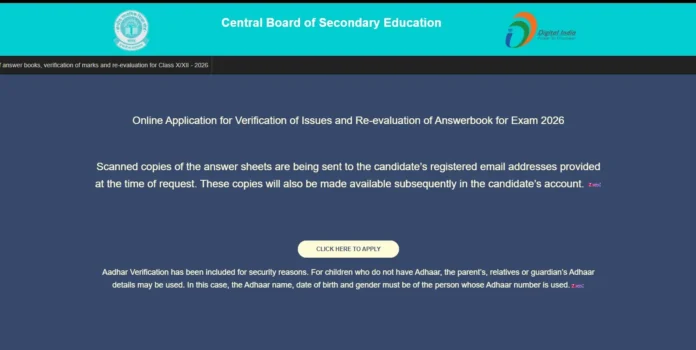
New Delhi, June 4: The Central Board of Secondary Education (CBSE) has received an overwhelming response to its answer-sheet verification and re-evaluation process, with more than 56,000 applications submitted by students within days of the facility becoming available.
At the same time, the Board revealed that it successfully defended its online systems against a major cyber attack, ensuring uninterrupted access to services for students seeking review of their examination results.
In a statement issued through its official communication channels, CBSE said more than 56,000 applications for verification of marks and re-evaluation had been accepted by 9.30 p.m. on Wednesday, reflecting significant interest among students in reassessing their examination outcomes.
The Board also disclosed that its digital infrastructure faced a large-scale denial-of-service (DoS) attack involving approximately 3.8 million malicious data packets. According to officials, the attack was successfully neutralised without disrupting the functioning of the online portal.

“Our technical teams are proactively monitoring performance and introducing refinements to deliver a smoother, faster, and more seamless experience for students,” the Board said.
The online facility for verification of marks and re-evaluation of answer scripts was activated on June 2 and will remain open until midnight on June 6. Students wishing to seek review of their marks are required to submit applications exclusively through the online portal, as offline applications are not being accepted.
Under the current fee structure, students are required to pay ₹100 per subject for verification of marks and ₹25 per question for re-evaluation. CBSE has also introduced Aadhaar-based authentication for applicants this year as an additional security measure aimed at ensuring the authenticity of requests and preventing misuse of the system.
The large number of applications comes amid heightened attention on the Board’s evaluation processes following controversy surrounding the recently introduced On-Screen Marking (OSM) system.
The digital evaluation system, designed to modernise answer-sheet assessment and improve efficiency, has faced criticism from students, parents, and education stakeholders over alleged discrepancies in the marking process.
Concerns raised in recent weeks have included allegations of answer-sheet mismatches, marking inconsistencies, data-entry errors, and grade allocation issues. These complaints have triggered broader scrutiny of the implementation and management of the OSM system.
The issue gained further prominence after a Class 12 student, Sarthak Sidhant, presented his observations regarding the evaluation process before a parliamentary committee on education. His presentation reportedly received appreciation from members of the panel and contributed to wider discussions on examination reforms and transparency.
The controversy also coincided with administrative changes within CBSE. Earlier this week, Rahul Singh and Himanshu Gupta were transferred amid concerns related to the implementation of the digital evaluation system.
In response to the allegations and growing public attention, the government has constituted a one-member inquiry committee to examine the procurement and implementation of OSM services.
The committee is headed by S. Radha Chauhan and has been tasked with conducting a detailed review of the system and submitting its findings to the Department of Personnel and Training within one month.

Education experts note that the outcome of the inquiry could influence future reforms in the country’s examination and evaluation systems, particularly as education boards increasingly adopt digital technologies to manage large-scale assessments.
Meanwhile, CBSE has assured students that all applications for verification and re-evaluation will be processed according to established procedures. The Board has also reiterated its commitment to maintaining transparency, fairness, and efficiency throughout the review process.
With thousands of students awaiting the outcome of their applications and an official inquiry underway into the evaluation system, the coming weeks are expected to be significant for both students and policymakers seeking to strengthen confidence in one of India’s largest school examination boards.