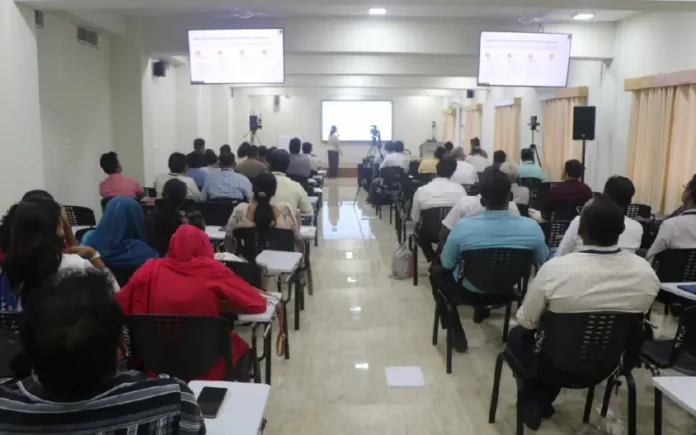
Sri Vijaya Puram, Aug. 3: Strengthening waste management systems through trained personnel and institutional coordination took centre stage as the Andaman and Nicobar Pollution Control Committee (ANPCC) concluded a two-day Union Territory-level Master Trainer Capacity Building Workshop on Operationalizing Solid Waste Management and Plastic Waste Management in Sri Vijaya Puram. The programme aimed to equip representatives from government agencies and other stakeholder organisations with the knowledge required to support the implementation of waste management practices across the islands.
The workshop, organised by the ANPCC under the Department of Science and Technology in association with the Centre for Science and Environment (CSE), New Delhi, concluded on July 29 at the Training Hall of the Directorate of Disaster Management, Sri Vijaya Puram.
The programme was conducted under Phase-II of the India–Norway Marine Pollution Initiative (INMPI) of the Ministry of Environment, Forest and Climate Change (MoEF&CC), Government of India. Around 60 participants representing 23 stakeholder departments and organisations attended the workshop. The participants included representatives from government departments, local bodies, non-governmental organisations (NGOs), civil society organisations (CSOs), self-help groups (SHGs) and other stakeholders.

During the two-day programme, participants received training on key components of Solid Waste Management and Plastic Waste Management. The sessions covered source segregation, Material Recovery Facilities (MRFs), Extended Producer Responsibility (EPR), compliance requirements for Bulk Waste Generators (BWGs), sustainable waste management practices and practical exercises designed to strengthen implementation at the institutional level.
The valedictory session was attended by the Member Secretary of the Andaman and Nicobar Pollution Control Committee-cum-Director of Science and Technology, who distributed certificates to the participants upon completion of the workshop.

Addressing the gathering, the Member Secretary emphasised that compliance with waste management requirements should be adopted as a behavioural change rather than viewed solely as a regulatory obligation, particularly in the context of the directions issued by the Supreme Court. The participants were also urged to apply the knowledge gained during the workshop within their respective departments and organisations and contribute to the effective implementation of waste management measures.
The workshop concluded with participants designated as Master Trainers expected to carry forward the training within their respective institutions. By bringing together officials and stakeholders from multiple sectors, the programme focused on strengthening institutional capacity for implementing solid and plastic waste management practices across the Andaman and Nicobar Islands under the national marine pollution initiative.