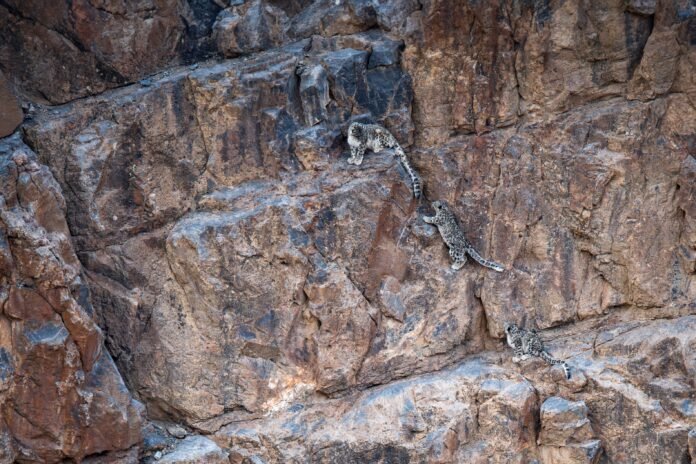
Sri Vijaya Puram, October 24: Strengthening wildlife monitoring and protecting fragile mountain ecosystems are crucial to the survival of snow leopards, conservationists have warned, as habitat pressures and human-wildlife conflict continue to threaten the elusive predator known as the “Ghost of the Mountains”.
On International Snow Leopard Day, the Ministry of Environment, Forest and Climate Change highlighted the importance of involving local communities in conservation efforts, including supporting livelihoods alongside the protection of snow leopard habitats.
In India, snow leopards are found across high-altitude, cold, arid and rugged landscapes in Jammu and Kashmir, Himachal Pradesh, Uttarakhand, Sikkim and Arunachal Pradesh. Their remote habitats and elusive behaviour make monitoring and conservation particularly challenging.
According to the Snow Leopard Population Assessment in India (SPAI) Report 2024, India is estimated to have 718 snow leopards, with Ladakh accounting for the largest share at approximately 477 animals, according to the Ladakh Union Territory Administration.
Globally, the snow leopard population is estimated to range between 3,500 and 7,000 individuals, according to the Snow Leopard Conservancy–India Trust (SLC-IT), which works to protect the species and other wildlife in Ladakh and Spiti.
Despite their wide distribution across mountainous regions, snow leopards face several threats. SLC-IT has identified poaching for pelts and body parts, declining prey populations, competition with domestic livestock for high-altitude pastures and retaliatory killings by communities whose livestock are attacked by the predators.
The organisation has also identified hydroelectric projects, mining and climate change as emerging pressures on snow leopard habitats.
The relationship between snow leopards and mountain communities remains central to conservation efforts. When predators kill livestock, families dependent on animals for their livelihoods can face substantial losses. Conservation programmes therefore need to combine wildlife protection with community participation and support for sustainable livelihoods.
The species’ reproductive pattern also makes population recovery slow. Female snow leopards generally give birth to only one or two cubs once every two years, leaving populations vulnerable to additional mortality and changes in their habitats.
SLC-IT describes snow leopards as an umbrella or keystone species whose survival is critical to the wider mountain ecosystem. As top predators, they form an important part of ecological systems that also support prey species and other wildlife.
Conservation efforts in Ladakh have also involved the Indian Army, which operates in high-altitude areas close to snow leopard habitats. The Army collaborates with civilian authorities to support wildlife protection and the conservation of fragile mountain environments.
On World Wildlife Day this year, the Fire and Fury Corps signed a Memorandum of Understanding with the Forest, Ecology and Environment Department of the Union Territory of Ladakh. Under the agreement, a Joint Snow Leopard Conservation Cell was established to monitor wildlife movements, share field observations from remote border areas and address threats such as free-ranging feral dogs.
The partnership also covers the protection of Himalayan wolves, Bharal or blue sheep, ibex, marmots and the black-necked crane. The initiative aligns with India’s commitments under the Global Snow Leopard and Ecosystem Protection Program (GSLEP).
The conservation challenge extends beyond counting individual animals. Protecting habitats, maintaining prey populations, reducing conflict with livestock owners and monitoring threats across remote mountain regions are all important to the species’ long-term survival.
For a predator adapted to some of the world’s harshest environments, survival increasingly depends on coordinated conservation measures that recognise both ecological needs and the communities living alongside it.