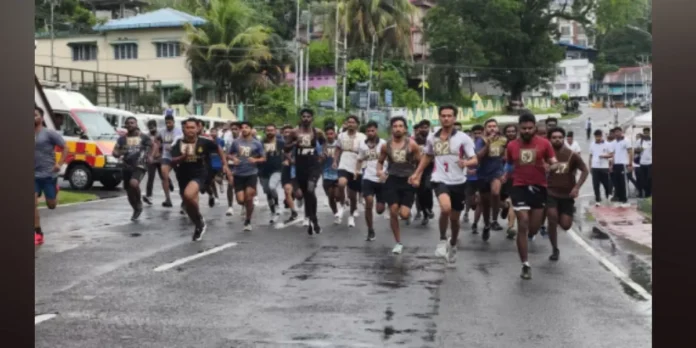
Sri Vijaya Puram, Sept. 24: The Andaman and Nicobar Police recruitment process has entered its physical testing phase across the islands, with hundreds of candidates appearing for the Physical Measurement and Endurance Test (PM&ET) at different centres. Yet, as candidates are being assessed on their physical endurance, the islands’ own sporting infrastructure raises a basic question: where are aspiring police personnel expected to train?
The PM&ET, being conducted as part of the police recruitment process, includes physical measurement and endurance components such as running, long jump and high jump. The tests are designed to assess whether candidates meet the prescribed physical standards for recruitment.
The recruitment process has already seen large numbers of candidates participate. In South Andaman, 4,707 candidates appeared in the first phase, with 1,796 qualifying after document verification and the prescribed physical assessment. In North and Middle Andaman, 914 candidates appeared, of whom 267 qualified.

The next phase began in Car Nicobar on September 21 and will continue until September 23. The PM&ET at Campbell Bay is scheduled from October 5 to 7, while testing at Sri Vijaya Puram is scheduled to continue until October 13.
But alongside the recruitment figures is a concern that extends beyond the examination itself.
Across the islands, candidates preparing for physically demanding examinations have limited access to properly maintained public sporting infrastructure. The Netaji Stadium, among the principal sporting facilities available in the islands, has for years faced questions over its upkeep and suitability for sustained athletic training.
The problem is not restricted to one stadium.
Playgrounds and open spaces that could otherwise serve as community sports facilities have steadily become unavailable for regular athletic use in several parts of the islands. For candidates preparing for recruitment examinations that demand running, jumping and endurance, the absence of properly maintained tracks and training grounds creates a significant gap between the physical standards being prescribed and the facilities available to prepare for them.
For a candidate preparing for a race, having access to a proper running track is not a luxury. It is a basic training requirement.
Candidates and those involved in preparation for physical examinations have also raised concerns over injuries and discomfort associated with practising on unsuitable surfaces. Reports of participants suffering hairline fractures, ligament injuries and other physical discomfort during preparation highlight the potential consequences when intensive running and jumping exercises are undertaken without suitable sporting infrastructure.
The issue also raises a larger question about how physical recruitment examinations are viewed in the islands.
The administration can reasonably point out that police personnel are required to work in difficult terrain, challenging weather and other adverse conditions. Police duties can demand physical resilience and the ability to respond in circumstances that are far removed from controlled training environments.
But preparing candidates for adversity should not mean exposing them to preventable risks because basic training infrastructure is unavailable.
There is a distinction between testing physical resilience and creating avoidable physical hazards.
A candidate should be tested on whether they can meet the prescribed endurance standards. Their ability to run on an appropriate track, train consistently and develop physical strength should ideally not depend on whether they can find a usable playground or a reasonably maintained stretch of road.
The present recruitment cycle therefore brings the condition of sporting infrastructure into sharper focus.

If the islands require physically capable police personnel, the preparation ecosystem also needs attention. Proper running tracks, maintained jumping pits, safe playing surfaces, access to drinking water and basic sports facilities can serve not only police aspirants but schoolchildren, athletes, defence aspirants and the wider community.
The current PM&ET schedule provides an opportunity to look beyond the recruitment numbers and examine whether the islands are providing adequate conditions for young people expected to meet demanding physical standards.
Recruitment authorities are responsible for conducting the examination according to notified rules. The wider administration, however, has a different responsibility: to ensure that the infrastructure needed for young people to prepare for such examinations exists and is maintained.
As candidates continue to run, jump and compete for a place in the police force, the question remains whether the islands’ sporting infrastructure is keeping pace with the physical demands being placed on their youth.