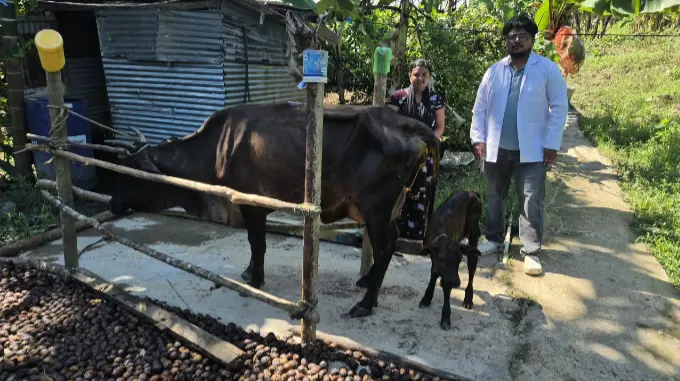
Sri Vijaya Puram, November 6: The Andaman and Nicobar Islands have recorded their first three female calves through Embryo Transfer Technology (ETT), marking the introduction of advanced cattle breeding techniques under island conditions. The initiative aims to improve the milk-producing capacity of local cattle, shorten the time required for genetic improvement and increase the availability of fresh milk.
The Department of Animal Husbandry and Veterinary Services (AH&VS) launched the programme in February 2026 in collaboration with Natern Dairy Services, a subsidiary of the National Dairy Development Board (NDDB). Under an agreement between the department and the organisation, embryos produced through in vitro techniques are transferred to local cattle to establish pregnancies carrying high-genetic-merit crossbred offspring.
Implemented under the Rashtriya Gokul Mission, the programme targets 220 pregnancies over two years. The department has completed five phases, carrying out 112 embryo transfers. Pregnancy has been confirmed in 29 recipient animals, while another 34 are awaiting confirmation.
The first female calf produced through the technology, named Shri, was born on November 1 at Kamraj Nagar. The second, Navya, was born at Manglutan, while the third, Sasi, was born at Port Mout. The department reported that all three calves are healthy and that the deliveries took place normally.

The technology is expected to reduce the time required to upgrade local cattle through crossbreeding. Under the existing artificial insemination process, genetic improvement takes three to four generations, or approximately 10 to 12 years. The department estimates that ETT can bring this period down to three to four years.
The calves produced through the programme have the potential to yield an average of 15 litres of milk daily. The department expects high-genetic-merit cattle and their offspring to help establish a dairy herd with greater milk-producing capacity and gradually replace low-yielding animals.
The initiative forms part of the department’s efforts to improve livestock productivity and strengthen fresh milk availability across the Islands.
The AH&VS department has acknowledged the beneficiary farmers and veterinary teams involved in embryo implantation, pregnancy monitoring and successful calving. It has also encouraged livestock farmers to access ETT and other advanced breeding services through their nearest veterinary institutions.
The department plans to extend the programme to additional areas in subsequent phases.