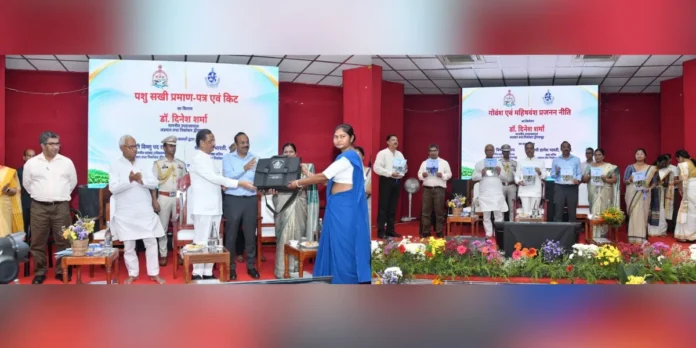
Sri Vijaya Puram, Nov. 27: Reducing dependence on mainland milk supplies and expanding local dairy production have emerged as key priorities for the Andaman and Nicobar Islands, with Lieutenant Governor Dr. Dinesh Sharma directing the Animal Husbandry Department to strengthen fodder infrastructure, improve livestock management and expand value-added dairy industries. He also called for regular monitoring of Pashu Sakhis, wider livestock insurance coverage and measures to prevent cattle abandonment.
The directions came during National Milk Day celebrations, where the Lieutenant Governor inaugurated a Model Fodder Tree Farm at Dollygunj and reviewed alternative feed production techniques. Developed across 1.89 acres, the facility houses 16 fodder tree species and six varieties of fodder grass suited to local agro-climatic conditions. It also demonstrates Azolla cultivation and hydroponic fodder production as alternative sources of animal feed.
Sharma called for wider dissemination of these techniques to improve fodder availability for cows, buffaloes, goats and other livestock, addressing one of the constraints affecting the expansion of animal husbandry in the Islands.
At the celebrations held at Tagore Government College of Education, he released the Cattle Breeding Policy and launched three categories of dairy products developed by ANIIDCO: buttermilk, khoya and three varieties of lassi. The programme also recognised livestock farmers and Pashu Sakhis through the distribution of animal nutrition kits, livestock insurance certificates and training-related materials.

Addressing the gathering, Sharma said increasing local milk production was necessary given the limited availability of fodder resources and the Islands’ dependence on supplies from the mainland. He appreciated the Department of Animal Husbandry and Veterinary Services for its work in indigenous cattle conservation, breed improvement and milk production despite geographical constraints.
The Lieutenant Governor referred to a proposed initiative to introduce around 500 cattle of improved breeds, including Sahiwal and Gir, and called for scientific research to improve breeding and milk yields. He also acknowledged the Department’s efforts towards achieving a production target of 12 to 14 litres of milk per animal per day.
Strengthening village-level livestock support formed another part of the directions. Sharma asked Pashu Sakhis to regularly visit villages and guide farmers on animal care, first aid and livestock management. He called for a monitoring mechanism, including an online portal through which they could upload field-visit details, services provided and photographs.
Around 60 per cent of the women enrolled under the initiative have received training, while each Pashu Sakhi receives a monthly honorarium of Rs. 3,000, he said.
On livestock insurance, Sharma highlighted that the Government bears 85 per cent of the premium, leaving farmers to pay the remaining 15 per cent. He urged livestock owners to use the scheme as financial protection against losses.
The Lieutenant Governor also called for developing industries based on cow dung and other cattle by-products, including tiles and roofing materials. He suggested collecting cow urine and exploring biogas generation to create additional income for livestock farmers and employment opportunities in rural areas. Citing the example of Amul and Banaskantha Dairy in Gujarat, he stressed the potential of milk processing and value-added products to generate economic activity.
Cattle abandonment was another concern raised during the programme. Sharma expressed concern over owners leaving animals on roads after they stop producing milk and directed the authorities to ensure animal tagging, identify owners and take action under the applicable rules.
He also directed officials to remove encroachments from grazing lands and develop adequate pastures. Referring to the 65-acre Kanha Upvan developed during his tenure as Mayor of Lucknow, he suggested exploring a similar model suited to local conditions through individual Gram Panchayats or groups of two to three villages.

The Lieutenant Governor further called for protecting the Islands’ remaining agricultural land, expressing concern over the declining area under cultivation. He urged farmers to grow fruits, vegetables and food grains alongside commercial crops to reduce dependence on mainland supplies and improve local food availability.
Sharma directed departmental officials to maintain continuity in the implementation of schemes, strengthen coordination and regularly assess ongoing initiatives, linking animal husbandry and dairy development with employment generation and economic self-reliance.
Member of Parliament Bishnu Pada Ray, Chief Secretary Gyanesh Bharti, Municipal Council Chairperson M. Vasantha, Zilla Parishad Adhyaksh P. Ummer, Secretary (Animal Husbandry and Veterinary Services) Pallavi Sarkar, Deputy Commissioner, South Andaman, Purva Garg, Superintendent of Police, South Andaman, Shweta Sugathan, and other senior officials attended the programme.