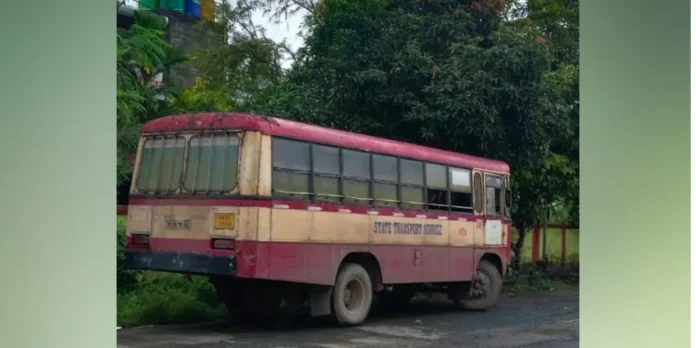
Sri Vijaya Puram, August 14: Sri Vijaya Puram may be witnessing a gradual expansion of public transport options, but the picture changes sharply once the focus shifts beyond the capital to the inter-island areas, where the State Transport Service (STS) remains the backbone, and in several places, the sole source of public road connectivity.
For many islanders, STS is not simply another transport option. It is the only practical and affordable way to reach workplaces, schools, markets, hospitals and government offices. With private bus operators having a limited presence across several islands, the availability and reliability of government buses assume even greater significance.
In Sri Vijaya Puram, commuters have access to a comparatively wider range of STS services. Regular buses, AC buses, electric buses and other services have expanded choices for passengers, while private operators supplement the government network and provide additional connectivity, particularly for last-mile travel.
This combination gives commuters in the capital a degree of flexibility.
But that flexibility becomes increasingly limited as one moves away from Sri Vijaya Puram.

Across the inter-island areas, commuters continue to face concerns over the number of buses available, service frequency, maintenance and the overall condition of the fleet. In several locations, the existing STS buses are ageing and, according to commuter concerns, some vehicles remain in poor or unserviceable condition.
The question, therefore, is no longer simply about how many buses STS has. It is also about what condition those buses are in.
Over the past few months, several STS buses have been involved in accidents, with some incidents leaving passengers injured, including cases involving serious injuries. While every accident requires an investigation and responsibility must be fixed wherever negligence is established, the circumstances surrounding such incidents raise a broader question about public transport safety.
Whenever a government bus is involved in an accident, the driver naturally becomes one of the first points of scrutiny. If an investigation establishes negligence or wrongdoing, appropriate action must follow. But treating the driver as the only possible point of failure risks overlooking other factors that can contribute to an accident.
Road conditions remain a persistent concern across the islands. Poor stretches of road, damaged surfaces, inadequate maintenance and challenging terrain can all increase the difficulty of operating a heavy passenger vehicle safely.
But the condition of the vehicle itself also matters.
A bus operating with ageing mechanical components, inadequate maintenance or other defects presents an additional safety challenge for both the driver and passengers. A driver can be held accountable for driving errors, but the responsibility for ensuring that the vehicle being placed on the road is roadworthy cannot rest with the driver alone.
That makes fleet maintenance and periodic replacement just as important as increasing the number of buses.
The issue becomes particularly serious in inter-island areas because private alternatives are limited. In Sri Vijaya Puram, a passenger may have the option of taking another bus if an STS service is delayed or unavailable. In remote areas, there may simply be no alternative.
An STS bus being withdrawn for repairs can therefore mean more than an inconvenience. It can affect a commuter’s ability to get to work, a student’s ability to attend school or a patient’s ability to reach a healthcare facility.

The government transport network in a geographically fragmented Union Territory has a responsibility that goes beyond conventional bus operations. Reliable connectivity has a direct bearing on access to education, healthcare, employment and essential services.
As STS modernises its services in the capital, the same focus needs to extend to the inter-island fleet—not only in terms of numbers, but also maintenance, roadworthiness, safety and timely replacement of ageing vehicles.
Because for the islander who has no private bus, no alternative route and no other affordable mode of transport, an STS bus is not merely a vehicle.
It is the connection to the rest of the island.
And that connection needs to be not just available, but safe and dependable.