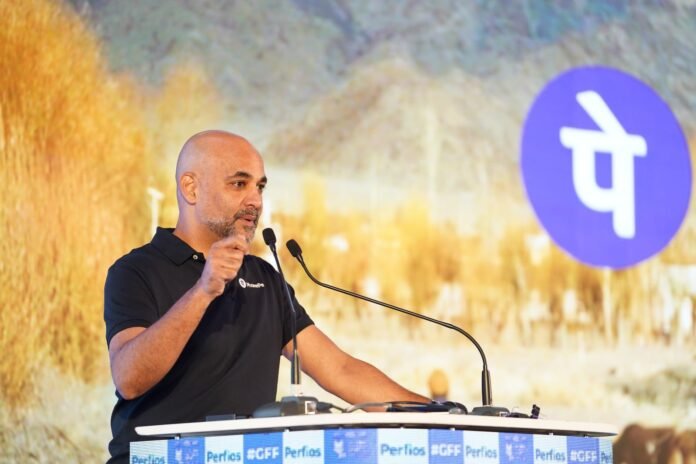
New Delhi, September 16: UPI customers will not be charged under the new Merchant Discount Rate (MDR) framework, while the revenue generated from eligible merchant transactions will help support the financial sustainability of India’s digital payments ecosystem, PhonePe CEO Sameer Nigam said on Wednesday.
Speaking to IANS, Nigam said customers would continue to use UPI without any charges, including for both person-to-person and person-to-merchant transactions.
“No, there are no fees for customers on UPI at all. Customers have never been charged for using UPI, nor will they be charged in the future,” Nigam said.
Under the new framework, merchants will pay a 0.4 per cent MDR on eligible UPI merchant transactions above Rs 2,000. Nigam said smaller merchants with an annual turnover below Rs 1 lakh would remain outside the MDR regime.
He also said that for larger merchants, transactions below Rs 2,000 would not attract MDR, covering what he described as 96 per cent of transactions.
The National Payments Corporation of India (NPCI) has introduced the revised MDR framework for specified person-to-merchant UPI transactions above Rs 2,000, with the new charges scheduled to take effect from October 15.
The MDR will be capped at Rs 300 for transactions of Rs 75,000 and above. The framework does not impose charges on person-to-person UPI transactions.
Nigam said the revenue generated through MDR would provide a funding mechanism for companies and banks that maintain and operate the UPI ecosystem.
“The industry spends about Rs 10,000 crore to Rs 12,000 crore a year minimum on just keeping UPI infrastructure alive,” he told IANS.
He said expenses extend beyond core infrastructure and include KYC processes, cybersecurity, risk management, fraud prevention, merchant chargebacks and capital expenditure.
“We needed a way to get that revenue back into the industry so that UPI grows in a sustainable manner,” Nigam said.
On concerns that merchants could pass the MDR cost on to customers, Nigam said customers would not face any additional cost and that merchants paying MDR would not be allowed to transfer the charge to consumers.
“There is no charge for the customer. Person-to-person is also free, person-to-merchant is also free,” he said.
Nigam also said he expected India’s digital payments market to continue expanding despite the introduction of the MDR framework.
According to him, UPI had around 20 crore users in 2020, while the user base has now increased to around 50–55 crore.
He said the introduction of a revenue model could also allow private fintech companies to increase spending on marketing, innovation and research and development.
“It is very important that businesses be able to make fair money,” Nigam said.
The MDR framework comes amid a wider debate over how India’s rapidly expanding digital payments ecosystem should be funded. Several brokerages have estimated that the new MDR could generate an annual revenue pool running into thousands of crores for banks, payment application providers and other participants in the ecosystem.
The eventual impact on individual companies will depend on transaction volumes, the proportion of eligible payments and the distribution of MDR revenue among different participants in the UPI ecosystem.