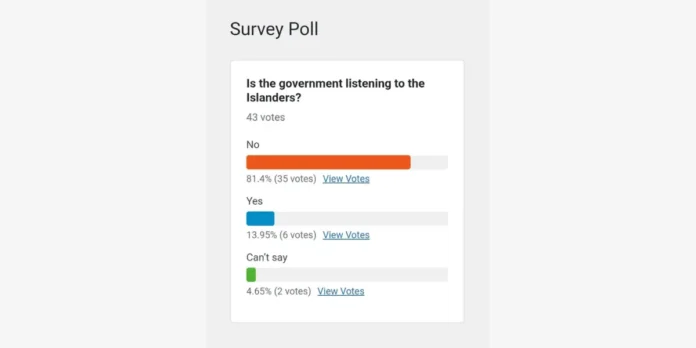
Sri Vijaya Puram, Sep 15: A public poll conducted by The Wave Andaman asking “Is the Government Listening to the Islands?” has brought a larger question of governance into focus as a series of concerns over connectivity, prices, healthcare, freight and infrastructure continue to surface across the Andaman and Nicobar Islands.
The poll offers readers three choices — Yes, No and Can’t Say. It is not a scientific opinion survey and does not represent the views of the entire island population. However, the question comes at a time when several issues reported from the Islands are increasingly moving beyond local discussions into administrative representations, political interventions and mainland policy conversations.
The pattern is significant.
For months, concerns over air connectivity, high airfares and reduced flight frequencies have remained among the most visible public grievances. The Wave Andaman reported that airfares on some mainland routes had climbed to as much as ₹40,000, with reduced flight availability affecting not only tourists but also patients, students, businesses and island residents travelling for essential purposes.

The issue subsequently moved beyond public discussion, with representations seeking intervention from the Centre and a public protest held outside Veer Savarkar International Airport on September 3.
What began as a transportation problem has consequently become an economic and governance issue.
For an island territory, air connectivity is not simply about tourism. Mainland access is essential for specialised healthcare, business, education, employment and family travel. High fares and reduced services therefore have a direct impact on the cost of living and doing business in the Islands.
The same vulnerability is visible in the supply chain.
Recent reporting on potato shortages showed retail prices reaching ₹150 a kg in several areas and up to ₹180 a kg at some locations. The episode highlighted the dependence of the Islands on mainland supply chains and the additional costs that can arise when supplies are disrupted.
Freight movement presents an even larger structural concern. The Wave Andaman reported that Chennai accounts for an estimated 75–85% of cargo reaching Sri Vijaya Puram, with around 4,000 TEUs of containerised cargo arriving monthly from Chennai, compared with approximately 300–400 TEUs from Kolkata, alongside break-bulk cargo.
The newspaper’s reporting also found that the entry of a new shipping operator had reduced logistics costs by nearly 40%, underscoring how competition and connectivity can directly influence prices in an island economy.
Healthcare provides another measure of how geography affects governance.
Recent concerns over the reported non-functioning of the blood-testing machine at Community Health Centre, Rangat, have highlighted the consequences of service gaps in Middle Andaman. For residents in remote areas, the absence of a diagnostic facility can mean additional travel, private laboratory expenses and loss of time and income.
On the mainland, a similar service disruption may be inconvenient. In the Islands, distance can turn it into a significantly greater burden.
Infrastructure concerns add another layer. Issues involving roads, water supply, electricity and maintenance continue to feature in public discussions and local reporting. A recurring concern is not merely whether infrastructure is being sanctioned or constructed, but whether it remains functional, accessible and adequately maintained after completion.
This is where the governance question becomes more complex.
The Andaman and Nicobar Islands are simultaneously being projected at the national level as strategically important to India’s maritime security, connectivity and blue-economy ambitions. Major infrastructure and strategic initiatives have placed the Islands increasingly within the national policy conversation.
Yet the everyday concerns of residents remain intensely local: Can people afford to fly to the mainland? Can essential commodities reach the market at reasonable prices? Can patients access basic diagnostic services? Are roads, power and water systems delivering consistently?
The growing visibility of these questions on the mainland is itself significant.

Issues that once remained largely within the Islands are now reaching ministries, Parliament, political representatives, industry bodies and national media. The airfare issue is one example of how a local grievance can evolve into a national policy discussion when its economic and social consequences become difficult to ignore.
The The Wave Andaman poll therefore should not be read as a referendum on any individual, party or government. Its significance lies in the question it places before policymakers.
The challenge is no longer simply whether development is taking place in the Islands. It is whether that development is translating into affordable connectivity, reliable public services, resilient infrastructure and a lower cost of living for the people who live here.
As the national importance of the Andaman and Nicobar Islands continues to grow, the question being asked locally is becoming increasingly relevant nationally:
When the Islands speak, how quickly does that voice translate into action?