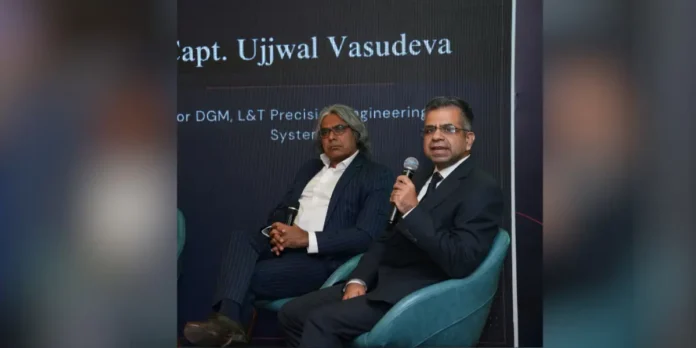
Sri Vijaya Puram, June 25: The strategic location of the Andaman and Nicobar Islands near the Malacca Strait could transform the region into a major maritime and industrial hub while creating an estimated 6,000 to 8,000 jobs, according to Captain Ujjwal Vasudeva of L&T Precision Engineering.
Speaking during a discussion on infrastructure and strategic development, Captain Vasudeva said the proposed large-scale projects in Great Nicobar have the potential to become a significant catalyst for economic activity, logistics services, maritime support infrastructure and employment generation. He emphasized that the islands occupy a geographically critical position along one of the world’s most important maritime trade routes.
Drawing parallels with recent global developments, he referred to the international focus on the Strait of Hormuz during the Iran-US conflict, where concerns over disruption to shipping highlighted the importance of maritime choke points in global trade.

He noted that the Andaman and Nicobar Islands are located close to the western entrance of the Malacca Strait, a route through which a substantial share of global trade and energy supplies transit. According to him, the islands are positioned in a strategically significant zone where nearly one-fourth of global trade passes and where East Asian economies depend heavily on maritime energy flows.
Captain Vasudeva described the proposed infrastructure initiatives as potentially transformative for the region, stating that India’s geographical advantage in the Indo-Pacific must be effectively utilized. He observed that while development may have come later than expected, the opportunity remains substantial.
Addressing the role of industry, he said L&T Precision Engineering remains willing to contribute to national infrastructure and defence-linked capabilities whenever opportunities emerge through government initiatives. He stated that the company participates in projects involving engineering, manufacturing and capability development and would be prepared to engage whenever requirements arise.
Focusing on maritime infrastructure, Captain Vasudeva highlighted the need to strengthen deep-water port facilities, merchant vessel support systems and ship repair services. He stressed that improving vessel turnaround times would be critical to enhancing competitiveness and attracting maritime business to the islands.
He pointed to established port ecosystems in Singapore and Sri Lanka as examples of efficient maritime operations and expressed confidence that similar capabilities could be developed in the Andaman and Nicobar Islands.

On employment prospects, he said infrastructure development would generate both direct and indirect jobs. Construction and facility development activities would create immediate employment opportunities, while long-term operations would require skilled manpower across multiple sectors.
According to Captain Vasudeva, future demand could emerge for welders, fitters, logistics personnel, project management professionals, port operators and maritime service providers. Taking various sectors into account, he estimated that between 6,000 and 8,000 jobs could be created through port services, repair facilities, logistics operations and associated industries.
His remarks positioned maritime infrastructure development in Great Nicobar as both a strategic and economic opportunity, linking the islands’ proximity to the Malacca Strait with India’s broader ambitions in trade, logistics and maritime connectivity.
Also Read: L&T Aims to Beat India’s Net-Zero Goal by 30 Years