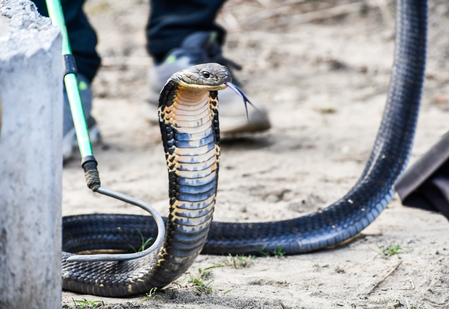
Kolkata, Aug. 26: Spectacled cobras found across different parts of mainland India may look noticeably different in colour, markings, behaviour and venom characteristics, but new genetic research suggests that they largely belong to one connected population rather than representing deeply separated evolutionary groups.
The findings come from the Evolutionary Venomics Lab (EVL), which studied the spectacled cobra (Naja naja), one of India’s most clinically significant venomous snakes and a species found across much of the country.
The research could have important implications for understanding snakebite biology and developing more effective anti-venoms, particularly in a country where snakebite remains a major public health concern.
The spectacled cobra is one of India’s “Big Four” snakes, a group responsible for a substantial proportion of serious and fatal snakebites. The research notes that snakebites collectively contribute to tens of thousands of deaths in India every year, making improved understanding of venom variation and snake genetics particularly important.
Researchers analysed nuclear and mitochondrial genetic markers from nearly 100 spectacled cobras collected from major biogeographical regions of the Indian subcontinent. The objective was to understand the species’ evolutionary history, genetic diversity and geographical origins.
Despite considerable differences in appearance and other characteristics across India, the genetic analysis did not reveal evidence of major phylogeographic divisions within mainland India.
The researchers described Naja naja as largely “panmictic” across mainland India. In biological terms, this indicates that the populations show extensive genetic connectivity rather than having evolved into strongly separated regional genetic groups.
Kartik Sunagar, associate professor at the Evolutionary Venomics Lab and one of the researchers involved in the study, explained that geographical variation does not necessarily mean that a species has split into distinct evolutionary lineages.
When a species occupies a vast geographical area, natural barriers such as rivers, mountains, deserts, climate changes and fluctuations in sea levels can isolate populations. Over long periods, isolated groups can accumulate genetic differences and eventually become distinct species.
In the case of India’s spectacled cobras, however, the genetic evidence indicates that this process of deep population separation has not occurred across the mainland to a significant extent.
“Across mainland India, the spectacled cobra appears to be largely one connected genetic population,” Sunagar explained, noting that genetic data did not support the existence of multiple deeply separated species despite variation in colour, markings, ecology and venom.
The finding is significant because venom composition can vary among snake populations, potentially affecting the effectiveness of antivenom treatment.
Understanding whether populations are genetically distinct can therefore help researchers determine how venom diversity has evolved and whether regional differences need to be considered when developing or deploying anti-venom products.
The study also sheds light on the evolutionary history of the spectacled cobra. Rather than supporting the idea that Naja naja migrated from Asia into Africa, the research supports an African origin for the genus Naja and a subsequent movement into South Asia during the Miocene epoch, between roughly 23 million and 5.3 million years ago.
According to the research, the species reached Asia through the Middle East before establishing itself in the Indian subcontinent.
The evolutionary history of the species also extends to Sri Lanka. Researchers found that Sri Lankan Naja naja are genetically distinct from mainland Indian populations. The findings are consistent with the possibility that spectacled cobras reached Sri Lanka from India during a period when lower sea levels created conditions that allowed movement between the landmasses.
This distinction between mainland and Sri Lankan populations demonstrates why genetics can be important even when snakes appear broadly similar.
The research has implications beyond taxonomy. Sunagar has pointed out that understanding differences in evolutionary history, relatedness and venom can influence approaches to anti-venom development, conservation and snakebite research.
The need for improved anti-venom is particularly important in India, where snakebite continues to cause significant mortality and morbidity, especially in rural and agricultural communities.
The Evolutionary Venomics Lab has also been working on new approaches to anti-venom development. In 2024, the laboratory reported developing a synthetic anti-venom, part of wider efforts to improve the way snakebite treatment is produced and administered.
One long-term objective of such research is to reduce the number of different anti-venoms that need to be stocked while ensuring effective treatment against medically important snake venoms.
The new genetic findings consequently provide another piece of the puzzle in understanding one of India’s most important venomous snakes.
The spectacled cobra may display striking geographical variation, but its genetic makeup across mainland India tells a different story, one of connectivity rather than deep evolutionary separation.
For scientists studying snake evolution and venom, that distinction could prove important in developing better strategies for snakebite prevention, treatment and conservation in the years ahead.