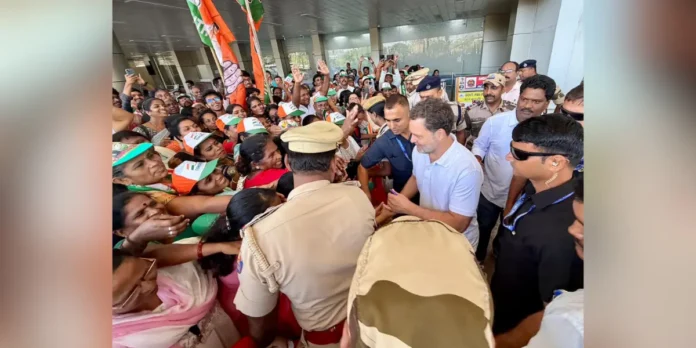
Sri Vijaya Puram, April 26: Emphasising the social harmony of the Andaman and Nicobar Islands, Rahul Gandhi described the archipelago as a “mohabbat ki dukaan” (a shop of love), underscoring its long-standing tradition of unity and coexistence among diverse communities.
Addressing a gathering at the Dr. B. R. Ambedkar Auditorium, Gandhi said the islands stand as a living example of India’s secular fabric, where people from different religions, cultures, and backgrounds live together with mutual respect.
“I made a mistake by not coming to these islands sooner and not including them in the Bharat Jodo Yatra,” Gandhi said, acknowledging the absence of the Andaman and Nicobar Islands from his earlier nationwide outreach.

“It’s a fight of vichardhara (ideology) and not politics,” he added, framing his remarks within an ideological narrative while reiterating his message of unity and inclusiveness.
He noted that unlike many regions where divisions are often highlighted, the Andaman and Nicobar Islands reflect a spirit of inclusiveness, with communities celebrating each other’s traditions and maintaining social cohesion. The remark was framed within his political messaging of “mohabbat ki dukaan,” a phrase he has used in recent public engagements to advocate for unity and counter divisive narratives.
Gandhi’s comments drew attention to the islands’ unique demographic composition, shaped by decades of migration from various parts of India. This diversity, he said, has fostered a culture where differences are not only accepted but embraced, creating a shared identity rooted in coexistence.

The statement resonated with sections of the audience, particularly in the context of ongoing political discourse around identity and social cohesion. Observers note that the Andaman and Nicobar Islands have historically been cited as an example of peaceful multicultural integration, with minimal instances of communal tension compared to mainland regions.
By invoking the phrase “mohabbat ki dukaan,” Gandhi positioned the islands as a symbolic counterpoint to narratives of division, suggesting that their social model offers lessons for the rest of the country.
The remarks form part of his outreach during the visit, where themes of unity, ideology, and grassroots realities have featured prominently in his interactions with local residents and stakeholders.