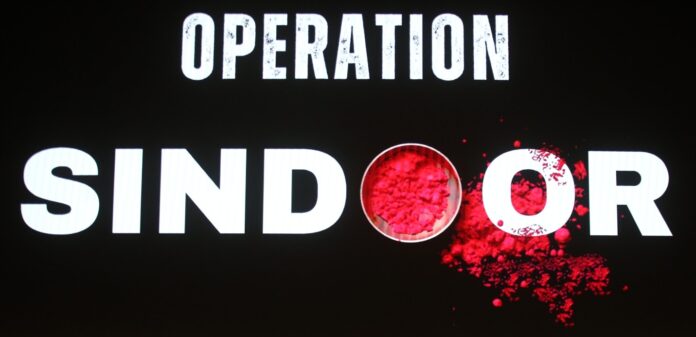
Jaipur, May 7: India’s top military leadership on Thursday declared that Operation Sindoor marked the beginning of a sustained and uncompromising anti-terror strategy, warning that future acts of terrorism or aggression would invite strong retaliatory action from the Indian Armed Forces. The message was delivered during a joint press conference held at the South Western Command in Jaipur on the first anniversary of the operation.
Senior officers from the Army, Navy and Air Force said the operation demonstrated India’s willingness to act decisively against terrorism and its support infrastructure, while reaffirming the country’s preparedness for future security challenges.
The briefing was attended by Deputy Chief of Integrated Defence Staff Lt Gen Zubil A. Minwalla, Lt Gen Rajiv Ghai, Air Marshal Avdhesh Kumar Bharti and Vice Admiral A.N. Pramod. Defence Minister Rajnath Singh was also scheduled to attend the anniversary event later in the day.

Addressing the media, Lt Gen Rajiv Ghai stated that Operation Sindoor established that no terrorist base inside Pakistan remained beyond India’s reach. He said the armed forces would continue taking necessary measures to safeguard national security and prevent attacks similar to the Pahalgam terror incident.
Lt Gen Ghai said India engaged nine targets during the operation, with seven struck by the Army and two by the Air Force. He claimed that more than 100 terrorists and over 100 Pakistani soldiers were killed during the military action. Referring to Pakistan’s information campaigns, he remarked that the neighbouring country invested more in propaganda than military preparedness.
He further said India halted operations only after Pakistan requested a ceasefire following significant losses. “We stepped back, but we did not show weakness,” he said, adding that the operation delivered a clear message that terrorism would come at a cost.
Air Marshal Avdhesh Kumar Bharti described the Pahalgam terror attack as a national tragedy and stated that the armed forces acted with complete operational freedom during the mission. He said the Army, Navy and Air Force coordinated jointly in planning and execution.
According to the Air Marshal, the operation targeted terrorist infrastructure and support systems while ensuring no civilian casualties or collateral damage. He claimed that nine terrorist hideouts in Pakistan and Pakistan-occupied Kashmir were destroyed, 11 airfields damaged and 13 aircraft shot down during the operation.

He said the situation escalated after Pakistan backed terrorist elements, turning the mission into an act of self-defence. “Our response was firm, lethal and extremely harsh,” he said, reiterating that India’s willingness for peace should not be mistaken for weakness.
Vice Admiral A.N. Pramod said Operation Sindoor reflected “Jointness, Atmanirbharta and Indigenisation,” highlighting seamless coordination among the three services and other national agencies. He said India’s military now possesses the capability to strike “deep, far and with precision, anytime, anywhere, anyhow.”
Lt Gen Zubil A. Minwalla linked the operation’s success to defence reforms initiated by the government, including the creation of the Chief of Defence Staff post. He said the armed forces are strengthening integrated command systems, data-centric warfare capabilities and layered protection mechanisms against drones and missile threats.
He also noted that close coordination with ISRO and the Department of Space was enhancing India’s real-time operational capabilities in the space domain.