
Sri Vijaya Puram, Aug 25: Andaman and Nicobar Islands has only three building projects listed on its official Real Estate Regulatory Authority (RERA) register, of which two are promoted by the Port Blair Municipal Council (PBMC) and only one by a private developer, even as real estate activity gathers pace across the islands.
The Tamil Nadu Real Estate Regulatory Authority (TNRERA), which covers Andaman and Nicobar Islands, lists a 24-unit residential project at Pahargaon promoted by Gangothri Builders and Traders, registered in 2018. The other two are residential-cum-commercial projects promoted by PBMC at Prothrapur and Brookshabad, registered in 2021.
The limited number of registrations comes amid an expansion in property activity in and around Sri Vijaya Puram, with apartment projects and plotted developments being marketed across several areas.
Property marketing has also increasingly moved to social media and WhatsApp groups, where plots, apartments, houses and other properties are routinely advertised. Brokers and other intermediaries are also actively facilitating transactions, according to people familiar with the local property market.
There have also been complaints from buyers alleging delays in delivery at some residential developments, including projects in Garacharma and School Line, among other areas. The Wave Andaman could not independently establish whether individual delays amount to contractual or regulatory violations.
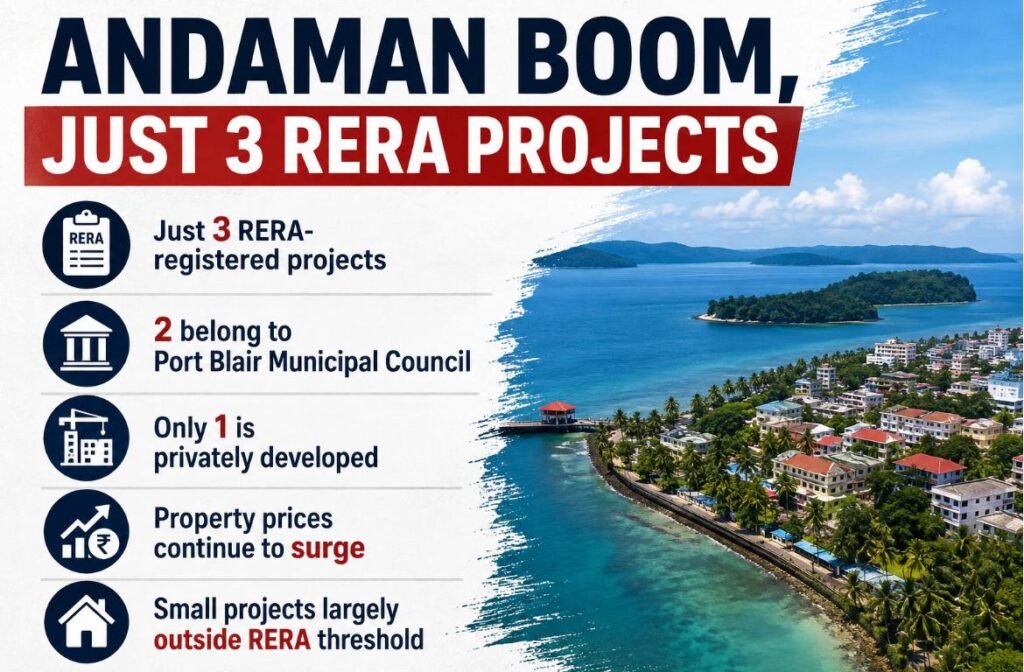
Threshold Relatively Low
Real estate experts said there is a widespread misconception that RERA applies only to apartment buildings. The Real Estate (Regulation and Development) Act, 2016, specifically covers qualifying real estate projects involving plots as well.
Section 3 prohibits a promoter from advertising, marketing, booking or selling any plot, apartment or building in a real estate project without RERA registration unless it qualifies for an exemption.
Under the Act, registration is not required where the area of land proposed to be developed does not exceed 500 square metres, or where the number of apartments proposed does not exceed eight, inclusive of all phases. The appropriate government can also reduce these exemption thresholds.
The 500-square-metre threshold translates into roughly 5,382 square feet, or 0.124 acre.

For plotted developments, experts said the relevant consideration is the land proposed to be developed as a real estate project rather than simply the size of each individual plot being sold.
The Andaman and Nicobar Administration had also stated in a 2017 public notice that RERA registration was mandatory where the project area exceeded 500 square metres or more than eight dwelling units were proposed.
An individual owner selling an existing parcel of land does not automatically become the promoter of a RERA project. However, where land is developed as an organised project for selling plots, it can fall within the ambit of RERA, subject to the statutory thresholds and exemptions.
The Act also provides that where a real estate project is developed in phases, each phase is treated as a standalone project for registration purposes.
The presence of only three projects on the publicly available Andaman building-project register does not establish that other developments are violating the law, as some could fall within exemptions. Real estate experts, however, said the limited number of registrations warrants scrutiny given the extent of property development and marketing now visible across the islands.
Brokers Also Covered
RERA also regulates real estate agents involved in projects covered by the Act.
The legislation broadly covers brokers, property dealers and middlemen receiving remuneration for facilitating transactions, including those introducing prospective buyers and sellers “through any medium”.
It is unclear how many intermediaries currently facilitating transactions in RERA-covered projects in Andaman hold valid RERA registrations.
Experts said the increasing use of WhatsApp and social media for property transactions does not by itself make a person a RERA-regulated agent. However, where an intermediary commercially facilitates transactions in a project covered by RERA, the regulatory requirements can apply irrespective of the medium used.
Non-compliance can also attract significant penalties.

Under Section 59, a promoter who fails to register a project despite being required to do so can face a penalty of up to 10 percent of the estimated cost of the real estate project. If the promoter continues the violation or fails to comply with orders issued in relation to the breach, the punishment can extend to imprisonment of up to three years, a further fine of up to 10 percent of the estimated project cost, or both.
Real estate agents face separate penalties. An agent violating Sections 9 or 10 can be fined Rs 10,000 for every day the default continues, cumulatively extending up to 5 percent of the cost of the plot, apartment or building for which the transaction was facilitated.
The expanding property market and reports of delayed delivery are now bringing the extent of RERA compliance in Andaman into focus.
Real estate experts said a review of ongoing plotted and residential developments could establish which projects cross the statutory threshold, which are exempt and whether projects requiring registration are operating outside the RERA framework.
With only three building projects appearing on the official Andaman RERA list, including just one promoted by a private developer, the widening gap between the islands’ real estate activity and its RERA footprint is likely to put greater focus on regulatory oversight.