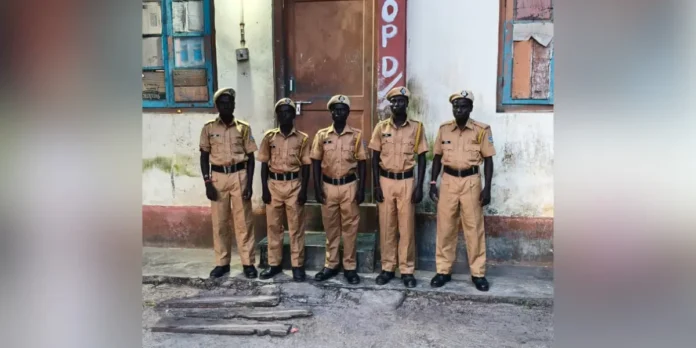
Sri Vijaya Puram, May 27: Onge youth helping police teams navigate the dense forests of Little Andaman during recent anti-narcotics operations have brought into focus a new line of defence in the Andaman and Nicobar Islands. During operations near Dugong Creek in January and the Pagla Mundi forest belt in April, Onge Home Guards Raja and Jhaj assisted police teams with their familiarity with forest routes, hidden access paths, creek-side movement and environmental indicators, according to details shared with The Wave Andaman. The operations led to the recovery of nearly seven kilograms of methamphetamine from remote jungle areas in January and a further recovery of crystalline methamphetamine in April, highlighting the growing use of isolated forest and coastal stretches by traffickers seeking to evade detection.
The role played by the two Home Guards has drawn attention to a wider development in the islands: the induction of eight members from the Onge and Great Andamanese communities into the Andaman and Nicobar Home Guard Organisation. The batch includes five Onge members from Little Andaman and three Great Andamanese volunteers from Strait Island. In numerical terms, the induction may appear modest. In governance and security terms, however, it marks a significant shift in the way indigenous communities are being engaged within formal state institutions in the islands.
For decades, the Onges of Little Andaman and the Great Andamanese of Strait Island were largely discussed through the language of protection, isolation, welfare and preservation. Public policy around the Particularly Vulnerable Tribal Groups of the islands focused mainly on shielding these communities from outside pressures. The Home Guard initiative marks a departure from that pattern by placing members of these communities inside an operational public security structure rather than leaving them only at the margins of governance.

The recruits were trained before being deployed. A month-long training programme conducted in September 2025 covered physical drills, weapon handling, disaster response, rescue operations, traffic management, legal awareness and first aid. They have since been engaged in patrolling duties, coastal surveillance, beach security, disaster response and awareness campaigns across multiple police establishments. That gives the initiative a significance beyond symbolism. It was not designed merely to showcase inclusion, but to assign operational responsibilities to tribal youth in areas where terrain familiarity can make a real difference.
Changing security model
The relevance of that shift becomes clearer in places such as Little Andaman, where policing is shaped as much by geography as by manpower. Dense forests, mangroves, creeks and remote coastal stretches are not always easy to monitor through routine patrol systems or official maps. In such areas, familiarity with the land can become a critical operational advantage. The anti-narcotics recoveries in Dugong Creek and Pagla Mundi reinforced that point by showing how difficult terrain can complicate enforcement work and how indigenous knowledge can help bridge those gaps. The commendation certificates and cash rewards awarded to the volunteers later reflected official recognition of that contribution.

The development also has wider relevance for the islands’ security landscape. The Andaman and Nicobar Islands face a growing range of challenges, including narcotics trafficking through maritime routes, illegal movement across remote coastlines, climate-linked disasters and environmental vulnerabilities in isolated regions. These are not challenges that can always be addressed through conventional enforcement alone. They require local intelligence, trust and an intimate understanding of terrain. By bringing Onge and Great Andamanese youth into the Home Guard system, the administration appears to be acknowledging that indigenous knowledge can strengthen public institutions in practical ways.
The inclusion of Kelu, the only woman recruit in the current batch, adds another dimension to the initiative. In communities where opportunities for formal institutional engagement have historically remained limited, her participation points to a widening of opportunity in public service roles. At the same time, the larger success of the model will depend on how carefully it is handled. The integration of PVTG members into policing structures, the material notes, must not become exploitative or politically performative. It must remain voluntary, informed and sensitive to community concerns, while broader issues relating to healthcare, education, nutrition and cultural preservation continue to be addressed.
Senior police officials said the induction of Onge and Great Andamanese youth into the Home Guard Organisation was giving policing in the islands a new operational edge. They said the role played by the recruits in recent anti-narcotics operations had highlighted the value of local terrain knowledge in remote forest and coastal areas where conventional enforcement often faces constraints. In regions such as Little Andaman, officials said, familiarity with the landscape was proving to be a practical asset.