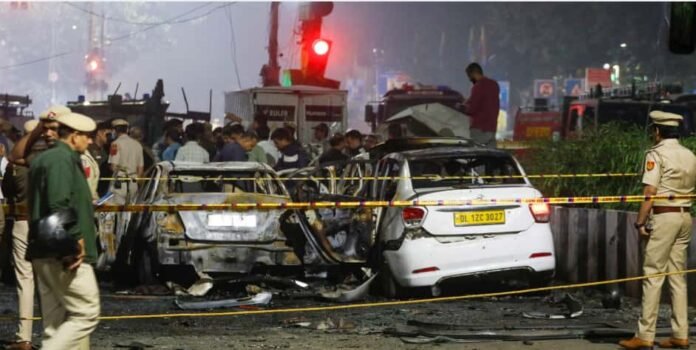
New Delhi, May 14: The National Investigation Agency on Thursday filed a 7,500 page chargesheet against 10 accused in connection with the deadly car bomb explosion near the Red Fort area of the national capital that killed 11 people and injured several others.
The high-intensity Vehicle-Borne Improvised Explosive Device (VBIED) blast took place on November 10, 2025, causing extensive damage to nearby structures and triggering a nationwide security alert.
According to the NIA, all 10 accused named in the chargesheet were allegedly associated with Ansar Ghazwat-ul-Hind (AGuH), a group considered an offshoot of Al-Qaida in the Indian Subcontinent (AQIS). The Ministry of Home Affairs had declared AQIS and its affiliated organisations as terrorist entities in 2018.

Among those named in the chargesheet is Dr Umer Un Nabi, identified by investigators as the alleged mastermind behind the conspiracy. Officials said Nabi died in the blast itself, and charges against him have been proposed to be legally abated.
Originally from Pulwama in Jammu and Kashmir, Nabi had reportedly worked as an Assistant Professor of Medicine at Al-Falah University in Faridabad, Haryana.
The other accused named in the chargesheet are Aamir Rashid Mir, Jasir Bilal Wani, Dr Muzamil Shakeel, Dr Adeel Ahmed Rather, Dr Shaheen Saeed, Mufti Irfan Ahmad Wagay, Soyab, Dr Bilal Naseer Malla and Yasir Ahmad Dar.
The chargesheet has been filed under multiple provisions of the Unlawful Activities (Prevention) Act, 1967, Bharatiya Nyaya Sanhita, Explosive Substances Act, Arms Act and Prevention of Damage to Public Property Act.

Investigators stated that the case involved an extensive probe carried out across Jammu and Kashmir, Haryana, Uttar Pradesh, Maharashtra, Gujarat and the Delhi-NCR region.
According to the agency, the investigation includes 588 witness statements, more than 395 documentary records and over 200 seized exhibits and material objects collected during searches and forensic examination.
The accused were radicalised through extremist propaganda linked to AQIS and AGuH and were part of a larger conspiracy aimed at carrying out terror activities in India.
The NIA claimed that several among the accused, including medical professionals, became actively involved in the planning, recruitment and logistical aspects of the alleged terror network.
Investigators further alleged that in 2022, some of the accused regrouped during a secret meeting in Srinagar after a failed attempt to travel to Afghanistan through Turkey. During this meeting, the group allegedly revived the AGuH network under a new banner called “AGuH Interim”.
According to the chargesheet, the accused then allegedly launched a conspiracy referred to as “Operation Heavenly Hind”, which investigators claim was aimed at overthrowing India’s democratically elected government and establishing Sharia-based rule.
The agency alleged that as part of the conspiracy, the accused recruited individuals, circulated extremist propaganda and procured arms, ammunition and explosive materials.
Investigators said the accused also conducted experiments to manufacture different types of Improvised Explosive Devices (IEDs) using commercially available chemicals.
According to the NIA, forensic analysis identified the explosive used in the Red Fort blast as Triacetone Triperoxide (TATP), a highly volatile explosive substance often associated with improvised bomb-making.
The agency alleged that the accused secretly procured chemicals and repeatedly tested explosive combinations in an effort to refine the device used in the attack.
Officials said Dr Umer Un Nabi was identified through DNA fingerprint analysis following the blast. The investigation also included voice sample examinations, digital evidence analysis and technical surveillance conducted at multiple locations connected to the accused.
Searches and forensic examinations were reportedly carried out in and around Al-Falah University in Faridabad and several areas of Jammu and Kashmir.
The NIA further alleged that the accused were involved in the illegal procurement of sophisticated weapons, including an AK-47 rifle, a Krinkov rifle and country-made pistols along with live ammunition.
Investigators also claimed the module was exploring the development of drone-mounted and rocket-based IED systems intended to target security establishments in Jammu and Kashmir and other parts of the country.
Officials stated that the accused had allegedly acquired laboratory equipment, electrical circuits, switches and chemical materials through both online and offline sources to support their activities.
The agency said the group was planning to expand its operations to other regions before the alleged network was dismantled during the investigation.
So far, 11 people have been arrested in connection with the case. The NIA stated that efforts are continuing to trace absconding suspects whose involvement emerged during the course of the investigation.