Dr. N. Francis Xavier
As an islander, I’ve always seen the Andamans as more than a postcard paradise. Our forests, beaches, and hills are sacred – living records of layered histories and silent stories that don’t make it into textbooks. But one story, hidden in plain sight at Kala Patthar – Black Rock – changed how I see not just the land I call home, but also what we owe to it.
And to my surprise, it wasn’t an islander who showed me this story. It was a visitor.
Professor Clare Anderson, a British historian with a passion for our islands’ colonial past, reached out to me after uncovering an 1876 letter in the British Library. The letter, written by a missionary named Rev. Warneford, mentioned carving his daughter’s name into a rock on Mount Harriet, now officially renamed Mount Manipur National Park. She asked if I’d join her in trying to find it. I’d walked those hills countless times. I was skeptical. How could a carving from 150 years ago have survived?
But something about her outsider’s curiosity stirred my own. We set off – Clare, myself, and Zubaire Ahmed, a local journalist and friend – on what we thought might be a fool’s errand. What we found was beyond expectation.
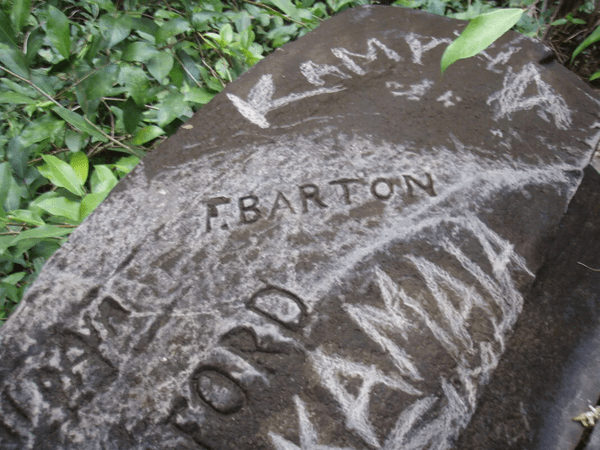
Through thick forest and up grueling terrain, we reached a massive black boulder half – lost in foliage – and found ourselves staring at names:
WARNEFORD. 1876.
F. BARTON.
HMS RIFLEMAN.
N. BALAGOOROO. C. RAMANOOJOOLOO.
F R de W.

Not just British names, but Indian ones too – perhaps soldiers, clerks, ship crew, or interpreters. The past, quite literally, carved into stone. I stood speechless.
For me, an islander, it was a gut – punch. How could we have let something so meaningful fade into obscurity? For Clare, a visitor, it was proof that the stories she suspected were real – tangible traces of colonial presence not preserved in archives, but embedded in our landscape. We had both seen the same rock, but through very different lenses. And both views mattered.
To us islanders, Kala Patthar is a wake – up call. We’ve worked hard to protect our biodiversity. But in doing so, we’ve too often overlooked our human history. We teach our children about the Cellular Jail – but what of the unnamed Indian aides whose names are here, unnoticed in the hills? We think we know these forests. Yet sometimes, it takes a visitor to show us what we’ve forgotten.
To visitors, Kala Patthar is more than a trekking spot. It’s a rare glimpse into the layered, complicated past of a place often marketed only for its beauty. The carvings expose not just colonial ambition but Indian agency. They invite questions. Who were these men? Were they free or coerced? What did they hope to preserve? For the historically curious, this is no less important than a monument in Delhi or London.
Kala Patthar is now defaced in parts – graffiti scrawled over precious names, sections chipped away by time and weather. This is how heritage vanishes: not in drama, but in silence and neglect. We can’t let this continue. Islanders and visitors alike must treat this site not as a footnote, but as a shared responsibility. We need documentation, protection, and above all, education.
Let it be a place where tourists learn history, not just take selfies. Let it be where island children learn that their heritage includes more than coral reefs – it includes complex human stories, too.
As we descended the trail that day, I felt many things – pride, awe, and a quiet sadness. Kala Patthar reminded me how fragile memory is. But it also reminded me of something else: that remembering doesn’t belong to any one group. Whether you’re born of this soil or drawn to it by curiosity, history calls to you all the same. And when it does, you answer not by walking past, but by pausing – and listening.
Let’s not wait until the echoes in the stone fade. Let us protect Kala Patthar – together.