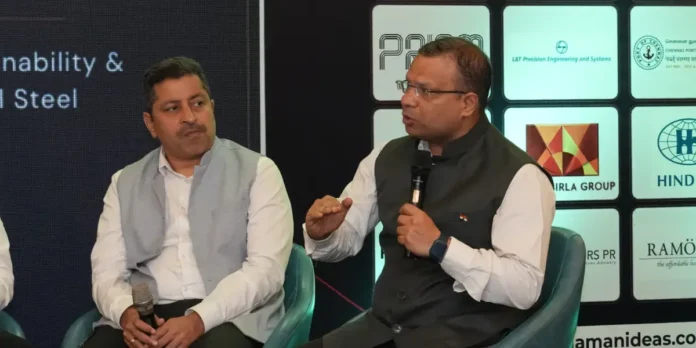
Sri Vijaya Puram, June 26: Small modular nuclear reactors (SMRs) could emerge as the long-term solution to the Andaman and Nicobar Islands’ growing energy needs, according to Jindal Steel’s Naveen Ahlawat, who said reliable and affordable electricity would be central to unlocking the next phase of the islands’ economic transformation.
Speaking at the Andaman Ideas Summit 2026, Ahlawat, President & Head –Sustainability & Decarbonisation Jindal Steel, said the islands must rethink their energy strategy as tourism, infrastructure and industrial activity expand in the coming years.
Responding to a question on whether power availability could become the biggest obstacle to the islands’ future growth, Ahlawat acknowledged the challenge but said the solutions already exist.
“Power availability is definitely an issue. But we have to bring the thinking in a different way,” he said.

He pointed out that much of the electricity generation across the islands continues to depend on diesel generator sets, making power generation both expensive and environmentally unsustainable.
According to Ahlawat, India’s remarkable progress in renewable energy provides an immediate opportunity for the islands to reduce costs through solar power integrated with battery storage.
“India has absolutely reached a peak in solar deployment. If you talk about solar plus battery, the cost has come down to around ₹3 per unit, which is among the lowest in the world,” he said.
He contrasted this with the cost of diesel-based generation in the islands, where electricity produced through generator sets costs around ₹25-26 per unit.
“The cost of electricity here is a whopping ₹25 to ₹26 per unit versus ₹3. That is a quick win. Solar plus batteries are absolutely implementable,” Ahlawat said.
He added that while the Central Government has already introduced several policy measures—including viability gap funding and production-linked incentives—to accelerate renewable energy deployment, the focus now should be on ensuring these schemes are effectively implemented on the ground.
“The schemes from Delhi are there. The challenge is taking them to the last mile,” he said.
While renewable energy could provide an immediate solution, Ahlawat said the islands must simultaneously begin planning for the next generation of power infrastructure.
He said small modular nuclear reactors (SMRs) have the potential to become a game-changing technology for island territories like the Andaman and Nicobar Islands because of their ability to operate efficiently on isolated electricity grids.
“A place like Andaman works very well in islanding mode. If the peak demand is around 200 megawatts, a 200-megawatt small modular reactor could potentially meet that requirement,” he said.
Unlike conventional nuclear power plants, SMRs are compact reactors that can be factory-built, transported to site and deployed closer to demand centres. Their smaller capacity and modular design make them particularly suitable for remote regions and island economies where large power stations may not be commercially viable.
Ahlawat noted that the Government of India has already begun investing significantly in the development of SMR technology as part of its long-term clean energy strategy.
He acknowledged that the economics currently favour renewable energy.
“At present, the cost is high. Small modular reactors are around ₹80 crore per megawatt, compared to roughly ₹4 crore for solar and about ₹8 crore for wind or thermal power,” he said.
However, he believes nuclear technology will become increasingly competitive as costs decline and electricity demand rises.

“If we talk about Andaman 2.0 and 3.0 as we move forward, nuclear is definitely one of the solutions,” Ahlawat said.
His remarks came during a wider discussion on infrastructure, logistics and industrial development, where speakers repeatedly emphasised that dependable electricity would be essential for supporting tourism, manufacturing, logistics, ports and strategic infrastructure across the islands.
As the Andaman and Nicobar Islands assume greater strategic and economic significance in the Indo-Pacific, participants at the summit argued that ensuring long-term energy security would be critical to sustaining future investment and growth.
For the islands, Ahlawat suggested, the energy transition need not be an either-or choice. Solar power backed by battery storage could provide an immediate reduction in electricity costs, while small modular nuclear reactors could eventually offer the stable baseload power required to support the next generation of economic development.