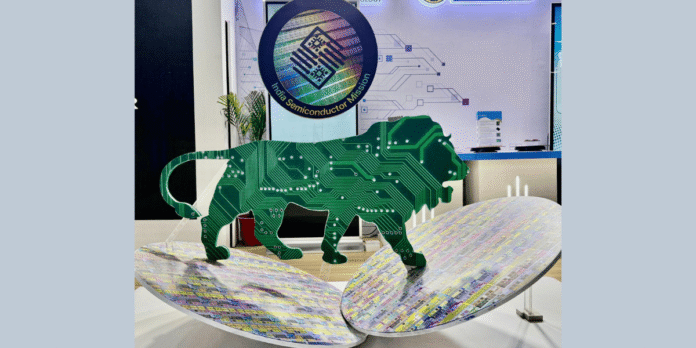
India’s electronics and semiconductor sector has transitioned from policy intent to large-scale execution, registering unprecedented growth over the past decade and positioning itself for record expansion in 2026 under the ‘Make in India’ initiative and production-linked incentive (PLI) schemes, according to government data and industry leaders.
Official figures show that India’s electronics production has risen nearly six-fold, from about ₹1.9 lakh crore in 2014–15 to approximately ₹11.3 lakh crore in 2024–25. Exports from the sector have witnessed an even sharper increase, climbing from ₹38,000 crore a decade ago to over ₹3.27 lakh crore during the same period, underlining the country’s growing role in global electronics supply chains.
The transformation is particularly visible in mobile phone manufacturing. From having just two manufacturing units in 2014–15, India now hosts around 300 such units. Mobile phone production value has surged from ₹18,000 crore to ₹5.45 lakh crore, while exports have jumped from ₹1,500 crore to nearly ₹2 lakh crore, reflecting both scale and export competitiveness.

Parallel to manufacturing growth, the government’s focus on infrastructure development through the Modified Electronics Manufacturing Clusters (EMC 2.0) scheme has further strengthened the ecosystem. Spread across 10 states, these clusters are projected to attract investments of ₹1.46 lakh crore and generate employment for nearly 1.8 lakh people, providing a foundation for sustained industrial expansion.
Industry representatives say 2025 marked a defining phase for India’s electronics sector. Pankaj Mohindroo, Chairman of the India Cellular and Electronics Association (ICEA), said the PLI framework has firmly established India as a competitive and trusted electronics manufacturing destination. According to him, the scheme has enabled rapid scaling, deeper localisation, export expansion and stronger integration into global value chains. He added that sustained policy continuity, faster approvals and a sharper focus on component ecosystems will be essential to move from volume-driven manufacturing to higher-value, innovation-led production in the coming years.
The electronics growth story, industry leaders argue, is no longer episodic but structural. Ashok Chandak, President of the India Electronics and Semiconductors Association (IESA) and SEMI India, said policymakers, global companies and domestic players are now aligned in building resilient and globally competitive value chains. He noted that discussions through 2025 highlighted the need to prioritise execution, joint research and development, academic partnerships and technology transfer to deepen value addition within the country.
India’s semiconductor journey has also gathered momentum, marking a shift from planning to implementation. Under the Semicon India Programme, 10 semiconductor-related units have been approved with a combined investment of ₹1.6 lakh crore. These include silicon fabs, silicon carbide fabs, advanced packaging facilities and memory packaging units, reflecting a broad-based approach to semiconductor manufacturing.

According to Chandak, disciplined execution and localisation across chip design, manufacturing and advanced packaging over the next three years will be critical to meet domestic demand for high-volume electronic products while strengthening supply resilience. The increased use of locally manufactured semiconductors and components is expected to play a central role in achieving deeper value addition and long-term sustainability.
The government’s PLI scheme for large-scale electronics manufacturing, covering mobile phones and specified components, has attracted investments worth ₹14,065 crore up to October 2025. In addition, the PLI scheme for IT hardware, aimed at boosting domestic manufacturing of laptops, tablets, servers and ultra-small form factor devices, has drawn investments of ₹846 crore during the same period.
Taken together, these initiatives underscore a significant structural shift in India’s manufacturing landscape. With policy frameworks firmly in place and execution accelerating across electronics and semiconductors, industry stakeholders believe 2026 could mark a new high point for India’s ambitions to emerge as a global manufacturing hub.