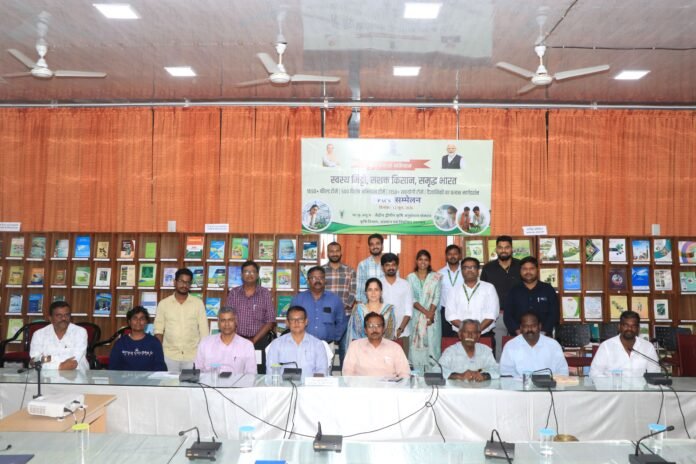
Sri Vijaya Puram, June 13: As part of the nationwide “Khet Bachao Abhiyan”, ICAR–Central Island Agricultural Research Institute (ICAR-CIARI) organised an interaction meeting with Primary Agricultural Credit Societies (PACS) in Sri Vijaya Puram on June 12, 2026, focusing on balanced fertiliser use, soil health management and sustainable agriculture practices.
The programme brought together presidents and secretaries of key village-level cooperative credit institutions functioning at the Gram Panchayat level, reinforcing the role of grassroots organisations in promoting scientific farming practices and responsible nutrient management among farmers.
Representatives from Chouldari Service Cooperative Society Ltd., Bharti Service Cooperative Society Ltd. (Ferrargunj), Pema Service Cooperative Society Ltd. (Teylorabad), and Netaji Service Cooperative Society Ltd. (Guptapara) participated in the meeting and shared perspectives on strengthening awareness about sustainable agriculture within their respective areas.
The interaction focused on the urgent need to promote balanced and judicious use of fertilisers to prevent soil degradation and ensure long-term agricultural productivity in the Islands.
Dr. Jai Sunder, Director of ICAR-CIARI, stressed that excessive and unscientific use of chemical fertilisers poses a serious threat to soil health and long-term sustainability of agriculture. He emphasised that restoring soil health requires a shift towards integrated nutrient management practices that combine organic inputs with scientific fertiliser application.
He advocated the promotion of biofertilisers and beneficial microbial agents such as Trichoderma and Pseudomonas, along with wider adoption of organic and natural farming practices to reduce dependence on chemical inputs.
Dr. Sunder highlighted the crucial role of PACS in bridging the gap between agricultural research institutions and farmers at the grassroots level. He urged cooperative representatives to actively collaborate with ICAR-CIARI and Krishi Vigyan Kendras (KVKs) to organise demonstrations, awareness programmes and training sessions on improved agricultural practices.
He also called for the promotion of vermicompost production at the village level to supplement nutrient requirements, reduce input costs and improve soil fertility. Emphasising financial inclusion in agriculture, he encouraged farmers to obtain Kisan Credit Cards (KCC) and undertake soil testing at least once every three years to enable informed fertiliser application.
Referring to the health implications of indiscriminate chemical usage, Dr. Sunder noted that excessive exposure to fertilisers and pesticides has been associated with several chronic health conditions, including kidney disorders and certain cancers. He reiterated that scientific and balanced nutrient management is essential not only for agricultural productivity but also for safeguarding human health and environmental sustainability.
During the programme, scientists also engaged with PACS representatives on safe and effective weed management practices. They advised the use of recommended green-label herbicides strictly as per scientific guidelines and cautioned that their effectiveness typically lasts for 15–20 days.
Experts further warned against spraying herbicides during rainy conditions, as rainfall immediately after application can reduce effectiveness and cause chemical runoff, potentially leading to environmental contamination. Farmers were encouraged to adopt integrated weed management techniques and adhere strictly to recommended dosage, timing and safety protocols.
Earlier, Dr. Y. Ramakrishna, Principal Scientist and Head of Krishi Vigyan Kendra (KVK), South Andaman, welcomed the participants and emphasised that PACS institutions play a vital role in disseminating scientific agricultural practices at the village level.
He urged cooperative representatives to identify training and demonstration needs in their respective areas and communicate them to ICAR-CIARI and KVKs so that targeted capacity-building programmes could be organised for farmers.
Dr. Ramakrishna also informed participants that scientific teams under the “Khet Bachao Abhiyan” are actively visiting villages across the Islands to raise awareness on soil health management, balanced fertiliser use and sustainable agriculture practices.
The programme concluded with a vote of thanks delivered by Subject Matter Specialist Shri Mohit, marking the end of an interaction that underscored the importance of grassroots institutions in driving sustainable agricultural transformation in the Andaman and Nicobar Islands.