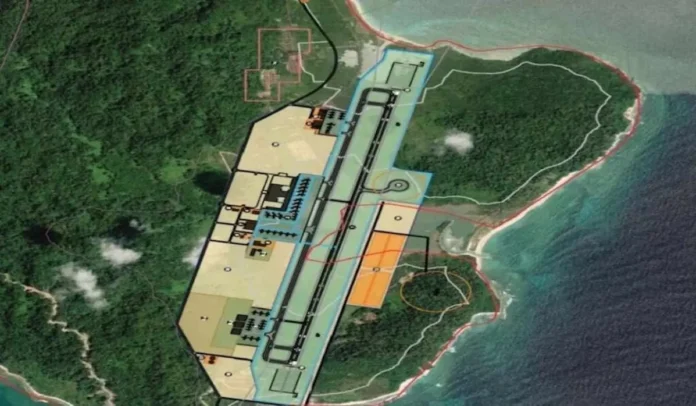
New Delhi/Sri Vijaya Puram, June 10: The proposed Great Nicobar Infrastructure Project could significantly enhance India’s military capabilities and maritime influence in the Indo-Pacific region, according to retired Major General Dhruv Katoch, who has described the development as both a strategic security asset and an economic opportunity.
Speaking in an interaction with IANS, Katoch said the project’s location near one of the world’s busiest maritime corridors gives India an opportunity to strengthen its presence in the Indian Ocean and support the security of international shipping routes.
The retired Army officer noted that the Andaman and Nicobar archipelago occupies a strategically important position between Myanmar to the north and Indonesia to the south. He highlighted the significance of the Six Degree Channel, located south of Great Nicobar Island, describing it as a critical sea lane connecting the Indian Ocean with the South China Sea and onward to the Pacific Ocean.
According to Katoch, a substantial share of global container traffic passes through this route, making it one of the most important maritime corridors in the region. A stronger Indian presence in the area, he argued, would provide New Delhi with greater leverage in maintaining secure and open shipping lanes.
“The Great Nicobar Project is being planned as both an expansion of military capability and a trans-shipment port,” Katoch said, adding that India has a strategic interest in ensuring uninterrupted maritime trade through the Indo-Pacific.
The proposed mega project, which includes a trans-shipment port, airport, township and power infrastructure, has been positioned by the government as a key component of India’s long-term maritime and economic strategy. Supporters argue that the project could transform Great Nicobar into a major logistics hub while improving connectivity and strategic preparedness.
Katoch said the deep natural harbour available at Great Nicobar offers favourable conditions for the development of a trans-shipment port. Such a facility, he suggested, could reduce India’s dependence on foreign ports such as those in Sri Lanka and Singapore for handling a large share of its cargo traffic.
The retired officer also linked the importance of maritime security to recent global developments. Referring to disruptions in international shipping routes during periods of geopolitical tension, he said India must safeguard critical sea lanes that support trade and energy supplies.
Beyond the strategic and economic dimensions, the project has also attracted significant environmental scrutiny. Conservationists and environmental groups have raised concerns over the potential impact of large-scale construction activities on forests, wildlife habitats and the indigenous communities inhabiting the island.
Addressing such concerns, Katoch maintained that development and environmental protection can proceed simultaneously. He expressed confidence that environmental considerations would be factored into the implementation process.
The remarks come as discussions surrounding the Great Nicobar Project continue to generate debate among policymakers, defence experts, environmentalists and local stakeholders.
While proponents view the project as a transformational opportunity that could strengthen India’s maritime position and economic competitiveness, critics have questioned whether the ecological and social costs have been adequately assessed.
The project remains one of the most closely watched infrastructure initiatives in the Andaman and Nicobar Islands, with its future likely to shape both the strategic and developmental trajectory of the region in the coming decades.