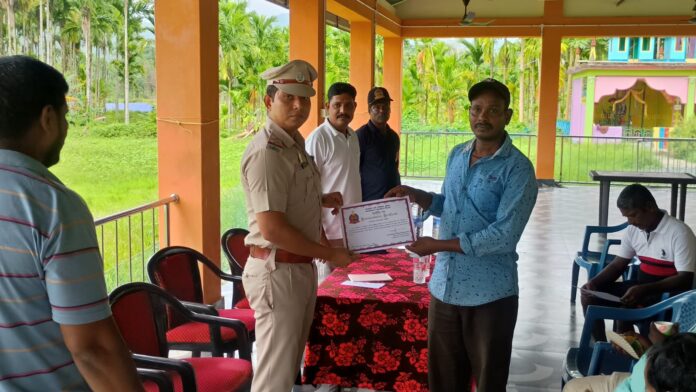
Sri Vijaya Puram, June 10: In a bid to strengthen coastal surveillance and community participation in maritime security, Kalighat Police conducted a Fishermen Watch Group meeting at Talbagan Community Hall, bringing together fishermen, local representatives and government functionaries from several coastal villages in North and Middle Andaman.
The programme, held on June 6, saw participation from around 50 fishermen representing Talbagan, Kishorinagar, Paschimsagar, Haren Nallah and Gopen Nallah. Local Sagar Mitras, the Pradhan of Gram Panchayat Paschimsagar and personnel from the Police Marine Force (PMF) also attended the meeting.
Police officials said the initiative was aimed at enhancing awareness on coastal security measures and strengthening the role of fishing communities as the first line of observation along the coastline. Given the strategic location of the Andaman and Nicobar Islands and the vast maritime area surrounding them, fishermen often play a critical role in detecting unusual activities at sea.
Addressing the gathering, SI Shibendra Halder, Station House Officer (SHO), Police Station Kalighat, sensitised participants about maritime vigilance and the importance of promptly reporting suspicious movements or activities in coastal waters. Fishermen were urged to remain alert while carrying out their routine fishing operations and to share information with authorities whenever required.
Officials highlighted how timely information provided by local fishermen in the past had contributed to successful anti-poaching operations and maritime enforcement activities. Such cooperation, police said, has helped authorities identify illegal activities and improve surveillance across vulnerable coastal stretches.
The meeting also focused on anti-poaching measures, a key concern in the ecologically sensitive waters of the Andaman and Nicobar Islands. Illegal fishing and poaching activities continue to pose challenges for marine conservation and resource protection efforts, making community participation an important component of enforcement strategies.
Police officials explained that fishermen, due to their regular presence at sea, are uniquely positioned to notice unusual vessels, unauthorized activities or movements that may otherwise go undetected. Strengthening communication channels between fishing communities and law enforcement agencies remains a priority for coastal security agencies.
The Fishermen Watch Group concept has been promoted across several coastal regions of the country as a community-based security mechanism that encourages active public participation in safeguarding maritime borders and coastal resources.
During the interaction, participants shared local concerns and discussed ways to improve coordination with security agencies. Officials reiterated that information provided by fishermen is treated confidentially and can play a crucial role in preventing unlawful activities.
A highlight of the programme was the recognition of fishermen who had contributed to maritime security and anti-poaching efforts through valuable information sharing. Appreciation certificates and cash rewards sanctioned by Police Headquarters were presented to selected fishermen in acknowledgement of their support.
Police officials said the awards were intended not only to recognise individual contributions but also to encourage wider community participation in coastal surveillance efforts.
The programme concluded with an appeal to fishermen to continue supporting law enforcement agencies by remaining vigilant and reporting any suspicious activities in coastal waters. Authorities expressed confidence that stronger cooperation between fishing communities and security agencies would further enhance maritime safety and environmental protection in the islands.