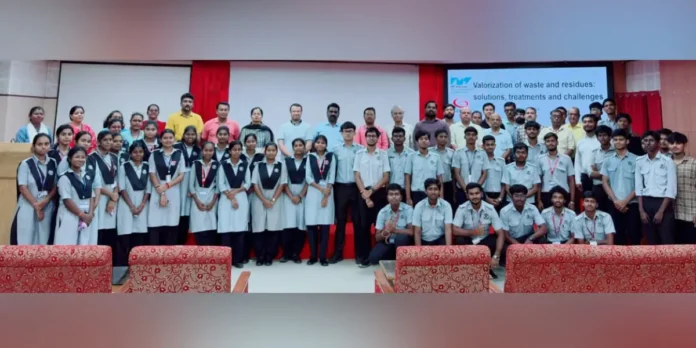
Sri Vijaya Puram, April 28: Emphasising sustainable waste management and environmental innovation, an expert lecture marking Earth Day 2026 was organised at Dr. B. R. Ambedkar Institute of Technology (DBRAIT), bringing together international expertise, academia, and industry stakeholders to discuss advanced waste-to-resource solutions.
The programme was jointly organised by DBRAIT in collaboration with the Department of Science & Technology (DST), Andaman and Nicobar Administration, Institution of Engineers (India), and the Chamber of Commerce at the DBRAIT Conference Hall.
The key highlight of the event was an expert lecture delivered by Prof. Khaled Loubar, Associate Professor at IMT Atlantique, Nantes, France, who presented his research on the valorisation of waste and residues. His lecture focused on treatment technologies, sustainable solutions, and challenges associated with transforming waste into usable resources.

The session was held in the presence of Prof. (Dr.) Sanmukh Kaur, Principal of DBRAIT, who attended as Chief Guest, and Devdas Paik, Honorary Secretary of the Institution of Engineers (India), who was the Guest of Honour. Officials noted that the programme was facilitated through the efforts of environmental engineer P. Uma Maheswar Rao of DST (ANPCC), an alumnus of DBRAIT and IIT Delhi, and coordinated by Altamash Mustafa, Assistant Professor (Civil Engineering) and Associate Dean IQAC, DBRAIT.
The lecture highlighted emerging technologies in waste management with specific relevance to island ecosystems such as the Andaman and Nicobar Islands. The expert discussed the integration of scientific research with practical implementation, focusing on sustainable environmental practices and innovative treatment methods for waste reduction and reuse.
An interactive session followed the lecture, where participants including members of the Institution of Engineers, representatives from the Chamber of Commerce, faculty members, students, and staff engaged in discussions on local waste management challenges. The session also explored opportunities for collaborative research in environmental technology and sustainable solutions.
Participants raised issues related to waste handling and management in island conditions, while the expert emphasised the need for research-driven approaches and technology adoption to address environmental concerns effectively.
The programme also encouraged students to pursue research in environmental sciences and engineering, strengthening academic engagement with real-world sustainability challenges. It reinforced institutional collaboration between DBRAIT, DST, professional bodies, and international academic institutions.
Organisers stated that the initiative contributed to raising awareness about environmental sustainability and innovation-driven solutions. The event also aimed to build stronger academic-industry linkages and promote scientific thinking among students and professionals.
The Earth Day programme concluded with a focus on environmental responsibility and the importance of integrating research, education, and policy for sustainable development in island regions.