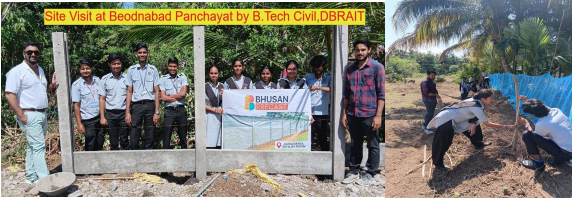
B.Tech Civil Engineering students of Dr. B. R. Ambedkar Institute of Technology gained practical industry exposure through a site visit and add-on industrial training programme focused on precast wall construction and sustainable civil engineering practices. The programme was organised for second-year students at an ongoing commercial construction site under Odyssey Infrastructure – Bhusan Precast at Beodnabad Panchayat.
The initiative was designed to bridge the gap between classroom-based theoretical learning and real-world construction practices. By taking students to an active project site, the programme aimed to familiarise them with contemporary construction technologies, site execution procedures, and quality control mechanisms used in modern civil engineering projects.
During the training, students were introduced to precast construction techniques, including the manufacturing and installation of precast wall elements. They were also exposed to construction sequencing, site planning, and workflow management, allowing them to observe how design concepts are translated into on-ground execution under real-time constraints.
The programme placed particular emphasis on sustainable and environment-friendly construction practices. Students were briefed on material optimisation, waste reduction, and the role of precast technology in improving efficiency while minimising environmental impact. Faculty members noted that such exposure is increasingly important as the construction sector moves towards greener and more resource-efficient practices.
The training sessions were conducted by Kingshuk Bala, an alumnus of the Civil Engineering programme, who currently runs a precast manufacturing unit. Drawing from his professional experience, he demonstrated practical aspects of site management and precast wall installation while explaining the advantages of prefabrication in terms of speed, quality consistency, and reduced on-site labour requirements.
The interaction also highlighted the role of innovation and entrepreneurship in the civil engineering sector. Students were introduced to the challenges and opportunities involved in setting up and operating a precast manufacturing enterprise, providing them with insights beyond conventional employment pathways in the construction industry.
Throughout the visit, students actively participated in discussions and closely observed live construction activities. The exposure helped them gain a clearer understanding of industry expectations, emerging trends in precast technology, and the practical application of sustainable construction concepts taught in classrooms.
Faculty members accompanying the students observed that such training programmes enhance industry readiness by equipping students with practical skills and contextual knowledge. The initiative also aligned with broader efforts to strengthen academia-industry linkages and prepare engineering graduates for evolving infrastructure demands.
The programme was organised and coordinated by Altamash Mustafa, Assistant Professor (Civil), Associate Dean, and Training and Placement Coordinator of the institute. Officials said the coordination ensured that the training remained focused on learning outcomes relevant to both academic curricula and industry requirements.
Students and faculty described the site visit as a valuable learning experience that complemented their academic studies. Many students noted that observing live construction processes helped them better understand design drawings, material behaviour, and on-site decision-making, which are often difficult to grasp fully in classroom settings alone.
The institute stated that similar industry-oriented programmes will continue to be organised to enhance experiential learning and improve employability outcomes for students. By integrating practical exposure with academic instruction, DBRAIT aims to prepare future civil engineers with the technical competence and adaptability required in a rapidly changing construction sector.