The Andaman and Nicobar Islands play a critical role in India’s environmental and economic security and represent a “living laboratory of biodiversity,” Union Minister of State (Independent Charge) for Science and Technology and Earth Sciences Jitendra Singh said during his recent visit to the Union Territory.
Interacting with scientists and officials at the Regional Centre of the Zoological Survey of India at Sri Vijaya Puram, the Minister underlined the strategic importance of the island ecosystem, stressing that advanced scientific research must be closely aligned with conservation priorities and sustainable livelihood generation. He emphasised the need for greater integration of scientific evidence with public policy, conservation planning, and community-level awareness to ensure long-term ecological balance.
The Minister noted that robust scientific institutions are essential to achieving India’s environmental objectives and unlocking the potential of the Blue Economy in a sustainable manner. According to him, organisations such as the Zoological Survey of India generate credible scientific data that directly informs national decision-making on biodiversity conservation, climate resilience, and ocean-based economic development.
Established in 1977, the Andaman and Nicobar Regional Centre of the Zoological Survey of India has completed nearly five decades of continuous scientific work in the islands. Over the years, the centre has emerged as a nodal institution for tropical island biodiversity research, undertaking close to 90 research programmes covering a wide range of faunal groups across terrestrial and marine ecosystems.
The scientific output of the centre has been substantial, with researchers publishing 85 books and more than 850 research papers in leading national and international journals. These contributions have significantly expanded India’s biodiversity knowledge base, particularly with respect to island ecosystems, endemic species, and fragile habitats unique to the Andaman and Nicobar archipelago.
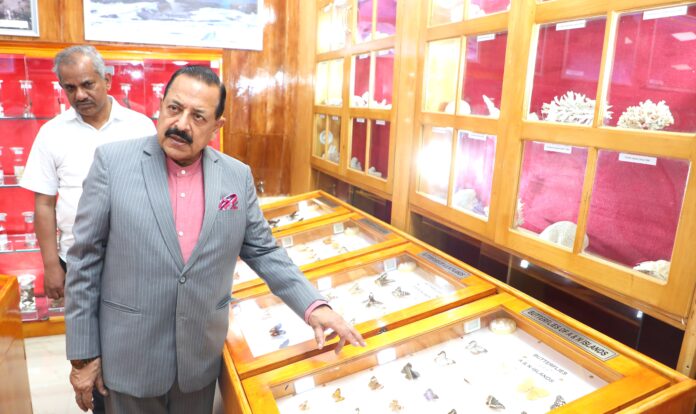
During the visit, the Minister also toured the Zoological Survey of India Museum, one of the prominent educational and tourism destinations in the islands. The museum houses around 3,500 specimens representing 22 faunal groups, offering visitors an overview of the region’s rich and diverse wildlife.
Officials briefed the Minister on the museum’s role in public outreach and environmental education. With an annual footfall ranging between 75,000 and 1,00,000 visitors, including students, researchers, and tourists, the facility serves as an important platform for raising awareness about biodiversity conservation. The curated reference collections, type specimens, and exhibits highlighting endemic, endangered, and threatened species of the archipelago drew particular attention during the visit.
The Minister was also apprised of the role of the ZSI Regional Centre as the nodal agency for India’s first National Coral Reef Research Institute. The institute has been conceived to strengthen coral reef research, monitoring, and conservation efforts in Indian waters, particularly in ecologically sensitive regions such as the Andaman and Nicobar Islands.
He observed that dedicated institutions focusing on coral reefs and marine ecosystems are crucial for protecting fragile ocean habitats and ensuring evidence-based marine governance. Such initiatives, he noted, are expected to play an important role in balancing ecological protection with sustainable economic activities linked to fisheries, tourism, and coastal livelihoods.
The visit underscored the growing emphasis on positioning the Andaman and Nicobar Islands not only as a biodiversity hotspot but also as a centre for advanced scientific research that can inform national and global conservation strategies. Officials indicated that continued investment in research infrastructure, institutional capacity, and community engagement would be essential to preserving the ecological integrity of the islands while supporting long-term development goals.